
Build An Extension End To End
This tutorial builds a small acme/announcement-bar package. It adds one settings group, one admin control page, one frontend render hook, cache invalidation for public output, and focused tests.
Use this shape for real packages: keep package logic in Actions/Data, register through Capell extension points, and prove the public output is safe.
Before copying code, make sure the job and package surfaces are clear. Package authoring jobs covers common extension jobs, and Extension surface vocabulary defines the surface, contribution, capability, install-impact, and marketplace terms used in this tutorial.
Target Behavior
Section titled “Target Behavior”The package should:
- store an announcement message and enabled flag;
- expose those settings in Admin;
- render a small public banner above the page content;
- avoid exposing admin/editor state in anonymous HTML;
- invalidate public pages when the announcement changes;
- be installable through Composer or Marketplace metadata.
announcement-bar/├── composer.json├── capell.json├── README.md├── config/announcement-bar.php├── database/settings/2026_01_15_000001_create_announcement_bar_settings.php├── resources/lang/en/form.php├── resources/lang/en/settings.php├── resources/views/frontend/banner.blade.php├── src/Actions/ResolveAnnouncementBarAction.php├── src/Actions/FlushAnnouncementBarCacheAction.php├── src/Admin/AnnouncementBarAdminBridge.php├── src/Data/AnnouncementBarData.php├── src/Filament/Pages/AnnouncementBarSettingsPage.php├── src/Filament/Settings/AnnouncementBarSettingsSchema.php├── src/Providers/AnnouncementBarServiceProvider.php├── src/Settings/AnnouncementBarSettings.php├── phpunit.xml.dist├── tests/TestCase.php├── tests/Pest.php└── tests/Feature/AnnouncementBarFrontendTest.phpEvery file in this tree is written out below. Settings migrations are timestamped like Laravel migrations (YYYY_MM_DD_HHMMSS_*); the settings migrator resolves them by name, so an untimestamped filename will not be published.
Keep the package small until this works. Add migrations, jobs, widgets, or Marketplace metadata only when the package really needs them.
To scaffold this layout instead of writing each file by hand, use php artisan capell:make-extension. Package authoring covers the scaffold profiles and install commands.
Boot Flow
Section titled “Boot Flow”flowchart LR Composer["Composer installs package"] --> Manifest["capell.json is read"] Manifest --> Provider["AnnouncementBarServiceProvider boots"] Manifest --> Enabled["Extension enabled?"] Enabled -->|"yes"| Provider Provider --> Settings["Settings class + schema registered"] Provider --> Admin["AdminBridge registered"] Provider --> Frontend["RenderHookRegistry callback registered"] Admin --> Editor["Admin edits message"] Editor --> Save["Settings page save() flushes frontend cache"] Save --> Public["Next public render uses fresh data"]Composer Metadata
Section titled “Composer Metadata”{ "name": "acme/announcement-bar", "type": "library", "autoload": { "psr-4": { "Acme\\AnnouncementBar\\": "src/" } }, "extra": { "laravel": { "providers": [ "Acme\\AnnouncementBar\\Providers\\AnnouncementBarServiceProvider" ] } }}The namespace should match the package. Do not place app-specific models or host project classes in reusable packages.
Provider placement
Section titled “Provider placement”Declare the bootstrap provider here only, and leave the capell.json provider buckets empty. Capell Core, Admin, and Frontend all do this.
Listing the same class in both places defeats the gating you want: Laravel’s package discovery boots a composer-declared provider unconditionally, while the manifest buckets are gated on the extension being enabled. A provider named in both runs even when the extension is disabled.
Installer and Marketplace do declare buckets, and both name a class that also appears in their extra.laravel.providers. They are deliberate exceptions: the installer must be reachable before anything is enabled, and both packages are part of the platform rather than optional extensions. Do not copy that shape into a new package.
Use the manifest buckets only for additional providers that must be gated — an install-only provider in install, or a second admin provider in admin. The bucket a provider sits in controls whether it loads at all; it does not filter by request context, so an admin provider still loads on frontend requests once the package is enabled. Keep admin-only work out of constructors and guard it inside the provider.
Config And Translations
Section titled “Config And Translations”->hasConfigFile('announcement-bar') merges this file at boot, so it must exist even if it is nearly empty:
<?php
declare(strict_types=1);
return [    'max_message_length' => 255,];
Translation keys are namespaced announcement-bar::<file>.<key>, so announcement-bar::form.enabled resolves to resources/lang/en/form.php:
<?php
declare(strict_types=1);
return [ 'announcement' => 'Announcement', 'enabled' => 'Show the announcement bar', 'message' => 'Message',];<?php
declare(strict_types=1);
// resources/lang/en/settings.phpreturn [ 'title' => 'Announcement Bar',];capell.json
Section titled “capell.json”{ "manifest-version": 3, "name": "acme/announcement-bar", "slug": "announcement-bar", "displayName": "Announcement Bar", "kind": "package", "capellApiVersion": "^1.0", "version": "1.0.0", "description": "Adds a site-wide public announcement banner.", "product": { "group": "Marketing", "tier": "standard", "bundle": "content-tools" }, "surfaces": ["admin", "frontend"], "dependencies": { "requires": [ "capell-app/core", "capell-app/admin", "capell-app/frontend" ], "supports": [], "conflicts": [] }, "providers": { "metadata": [], "install": [], "runtime": [], "admin": [], "frontend": [] }, "contributes": [], "database": { "migrations": false, "settings": true, "requiredTables": [] }, "actions": { "install": null, "setup": null, "uninstall": null, "afterInstall": null }, "settings": ["Acme\\AnnouncementBar\\Settings\\AnnouncementBarSettings"], "permissions": [], "capabilities": ["render-hook", "cache-invalidation"], "performance": { "cacheTags": ["announcement-bar"], "cacheSafety": { "cacheable": false, "sensitiveOutput": false, "queueInvalidation": true, "variesBy": [], "invalidationSources": [] } }, "healthChecks": [], "commercial": { "proposedLicense": "standard", "requestedCertification": "community", "supportPolicy": "community", "privateDocsRequested": false }, "marketplace": { "summary": "Adds a site-wide public announcement banner.", "screenshots": [], "categories": ["marketing"] }}The manifest is package metadata, not runtime logic. Runtime registration belongs in providers.
Three details are easy to get wrong:
settingsholds class-strings, not group names. The first entry is pushed intoconfig('settings.settings')during boot, so a group name such as"announcement-bar"produces a fatal error when Spatie tries to callannouncement-bar::repository(). Every shipped Capell manifest uses the fully-qualified settings class.database.settings: trueis what publishes and runs your settings migrations.InstallPackageActionpublishes the wholedatabase/settingsdirectory and then runs it. You do not need an install Action for this.- Declare the bootstrap provider in
composer.jsononly. The buckets stay empty here, as in Capell Core, Admin, and Frontend — see Provider placement below.
Keep dependencies.requires honest. This package registers admin and frontend surfaces, so it requires capell-app/admin and capell-app/frontend. Any package that registers an admin page, an Extensions page action, a Filament resource, or admin translations must require capell-app/admin.
This tutorial registers the render hook directly in the provider below. For a Marketplace-ready package, extract that hook into a class and declare it in contributes with type, class, and surface so manifest audits can trace the shipped runtime surface.
Lifecycle: actions and commands
Section titled “Lifecycle: actions and commands”The manifest has two different lifecycle blocks, and new packages should use only one of them.
| Block | Value | Status |
|---|---|---|
actions | Class-strings implementing PackageLifecycleAction | Current. Use this. |
commands | Artisan command names such as capell:blog-install | Legacy. CLI-only, and rejected by web installs. |
Recognised keys are actions.install, actions.uninstall, actions.setup, and actions.afterInstall. commands mirrors them with install, setup, demo, afterInstall, each with an optional *Params string list, plus doctor.
PackageLifecycleRunner prefers the Action whenever both are declared. When a lifecycle runs from a web-triggered install, legacy commands are refused outright:
Package %s declares legacy install command "%s", but web-triggered package lifecycle workmust use a lifecycle Action. Add actions.install to capell.json with a class implementingCapell\Core\Contracts\PackageLifecycleAction.So a commands-only package installs from the CLI but fails in the admin Marketplace flow. That is the single most common reason a package works locally and cannot be installed by a site owner.
The five Foundation packages still ship commands because they predate the Action contract and are only ever installed by the CLI installer. Do not copy that pattern into a new package.
A class-string that does not resolve fails the lifecycle loudly rather than being skipped:
Install lifecycle action Acme\AnnouncementBar\Actions\InstallAnnouncementBarActionfor acme/announcement-bar does not exist.A class that exists but does not implement PackageLifecycleAction throws a similar error. Both surface at install time, not at boot, and capell:extension-audit does not check them — so cover the wiring with a test.
Settings Data
Section titled “Settings Data”Use a settings class for persistent state and a Data object for the value passed to views.
<?php
declare(strict_types=1);
namespace Acme\AnnouncementBar\Data;
use Spatie\LaravelData\Data;
final class AnnouncementBarData extends Data{ public function __construct( public bool $enabled, public string $message, ) {}}<?php
declare(strict_types=1);
namespace Acme\AnnouncementBar\Actions;
use Acme\AnnouncementBar\Data\AnnouncementBarData;use Acme\AnnouncementBar\Settings\AnnouncementBarSettings;use Lorisleiva\Actions\Concerns\AsObject;
final class ResolveAnnouncementBarAction{ use AsObject;
public function handle(): AnnouncementBarData { $settings = app(AnnouncementBarSettings::class);
return new AnnouncementBarData( enabled: (bool) $settings->enabled, message: trim((string) $settings->message), ); }}The Blade view receives AnnouncementBarData. It should not read settings, query models, or inspect the current admin user.
Settings Class
Section titled “Settings Class”Persistent state extends Spatie\LaravelSettings\Settings. Capell requires SettingsContract so the group name is discoverable, and SettingsSchemaContract when the group should render through a Capell-generated admin form.
<?php
declare(strict_types=1);
namespace Acme\AnnouncementBar\Settings;
use Acme\AnnouncementBar\Filament\Settings\AnnouncementBarSettingsSchema;use Capell\Core\Contracts\SettingsContract;use Capell\Core\Contracts\SettingsSchemaContract;use Spatie\LaravelSettings\Settings;
class AnnouncementBarSettings extends Settings implements SettingsContract, SettingsSchemaContract{    public bool $enabled = false;
    public string $message = '';
    public static function group(): string    {        return 'announcement-bar';    }
    public static function schema(): string    {        return AnnouncementBarSettingsSchema::class;    }}
Property names are snake_case in shipped Capell settings groups. Every property needs a default: the settings migration writes the initial row, and a property without a default throws during group hydration if the migration has not run.
Do not type a property as a backed enum unless every persisted value is guaranteed valid. Capell’s own FrontendSettings deliberately stores visitor_language_detection as a string because an unrecognised persisted value would otherwise throw while the whole group hydrates.
Settings Migration
Section titled “Settings Migration”Settings migrations are Spatie settings migrations, not Laravel schema migrations. They live in database/settings/, return an anonymous class, and are keyed group.property:
<?php
declare(strict_types=1);
use Spatie\LaravelSettings\Migrations\SettingsMigration;
return new class extends SettingsMigration{    public function up(): void    {        if (! $this->migrator->exists('announcement-bar.enabled')) {            $this->migrator->add('announcement-bar.enabled', false);        }
        if (! $this->migrator->exists('announcement-bar.message')) {            $this->migrator->add('announcement-bar.message', '');        }    }};
Guard every add() with exists(). Reruns are normal — installs, upgrades, and repaired environments all replay these files — and an unguarded add() throws on the second run.
Publishing them from the package
Section titled “Publishing them from the package”You do not write any code for this. Setting "database": { "settings": true } in capell.json is the whole mechanism: InstallPackageAction publishes every file in your database/settings directory and then runs the settings migrator.
Two things it does that hand-rolled publishing usually gets wrong: it publishes with edit protection, so a migration the site owner has already customised is not silently overwritten, and it runs the settings migrator itself rather than leaving the group unmigrated.
->hasMigration() in configurePackage() is not the mechanism either. That is for Laravel schema migrations: spatie-package-tools resolves those names against database/migrations and publishes them to the application’s database/migrations, where the settings migrator never looks.
Never renumber or rename a shipped settings migration. Published files are tracked by name, so a rename republishes as a new migration and re-adds keys that already exist.
A lifecycle Action is for install work that Capell cannot infer from the manifest — seeding demo content, calling an external service, writing a non-settings config. Publishing your own settings migrations is not one of those cases.
Filament Settings Page
Section titled “Filament Settings Page”Extend AbstractPackageSettingsPage. It builds the form from the registered settings schema, so the page itself only declares which group it edits:
<?php
declare(strict_types=1);
namespace Acme\AnnouncementBar\Filament\Pages;
use Acme\AnnouncementBar\Actions\FlushAnnouncementBarCacheAction;use Acme\AnnouncementBar\Settings\AnnouncementBarSettings;use BackedEnum;use Capell\Admin\Filament\Pages\AbstractPackageSettingsPage;use Filament\Support\Icons\Heroicon;use Illuminate\Contracts\Support\Htmlable;use Override;
class AnnouncementBarSettingsPage extends AbstractPackageSettingsPage{    protected static string $settings = AnnouncementBarSettings::class;
    protected static string $settingsGroup = 'announcement-bar';
    protected static string|BackedEnum|null $navigationIcon = Heroicon::OutlinedMegaphone;
    protected static ?string $slug = 'announcement-bar';
    #[Override]    public function getTitle(): string|Htmlable    {        return __('announcement-bar::settings.title');    }
    #[Override]    public function save(): void    {        parent::save();
        FlushAnnouncementBarCacheAction::run();    }}
The save() override is what connects the settings form to cache invalidation — see Cache invalidation. Without it, the base class persists the settings and cached public HTML keeps serving the old message.
Signature details that differ from older Filament releases:
- Filament 5 uses
form(Schema $schema): SchemawithFilament\Schemas\Schema, notform(Form $form): Form.AbstractPackageSettingsPagealready implements it; override it only to depart from the generated form. protected static string $settingsis non-nullable — no?.$navigationIconis typedstring|BackedEnum|nulland takes aFilament\Support\Icons\Heroiconcase, not an icon-name string.- Layout components come from
Filament\Schemas\Components\*; inputs still come fromFilament\Forms\Components\*.
The matching schema class supplies the fields:
<?php
declare(strict_types=1);
namespace Acme\AnnouncementBar\Filament\Settings;
use Capell\Core\Contracts\SettingsSchema;use Filament\Forms\Components\Checkbox;use Filament\Forms\Components\TextInput;use Filament\Schemas\Components\Section;use Filament\Schemas\Schema;
class AnnouncementBarSettingsSchema implements SettingsSchema{    /**     * @return array<int, mixed>     */    public static function make(Schema $schema): array    {        return [            Section::make(__('announcement-bar::form.announcement'))                ->columnSpanFull()                ->schema([                    Checkbox::make('enabled')                        ->label(__('announcement-bar::form.enabled')),                    TextInput::make('message')                        ->label(__('announcement-bar::form.message'))                        ->maxLength(255),                ]),        ];    }}
Capell\Core\Contracts\SettingsSchema is a marker interface with no declared methods. The contract is enforced at call time instead: Capell invokes YourSchema::make($schema) and throws InvalidArgumentException with one of two messages —
- missing or non-callable
make(): “Settings schema %s must implement %s and define a callable static make method to render in the admin panel.” make()returns a non-array: “Settings schema %s::make() must return an array.”
Because the interface cannot enforce the method, PHPStan will not catch a wrong signature here; the failure surfaces when the settings page renders.
Field names must match the settings property names exactly (enabled, message), since the generated form hydrates and saves straight onto the settings class.
All labels go through translations. Do not inline user-facing English in a Filament component.
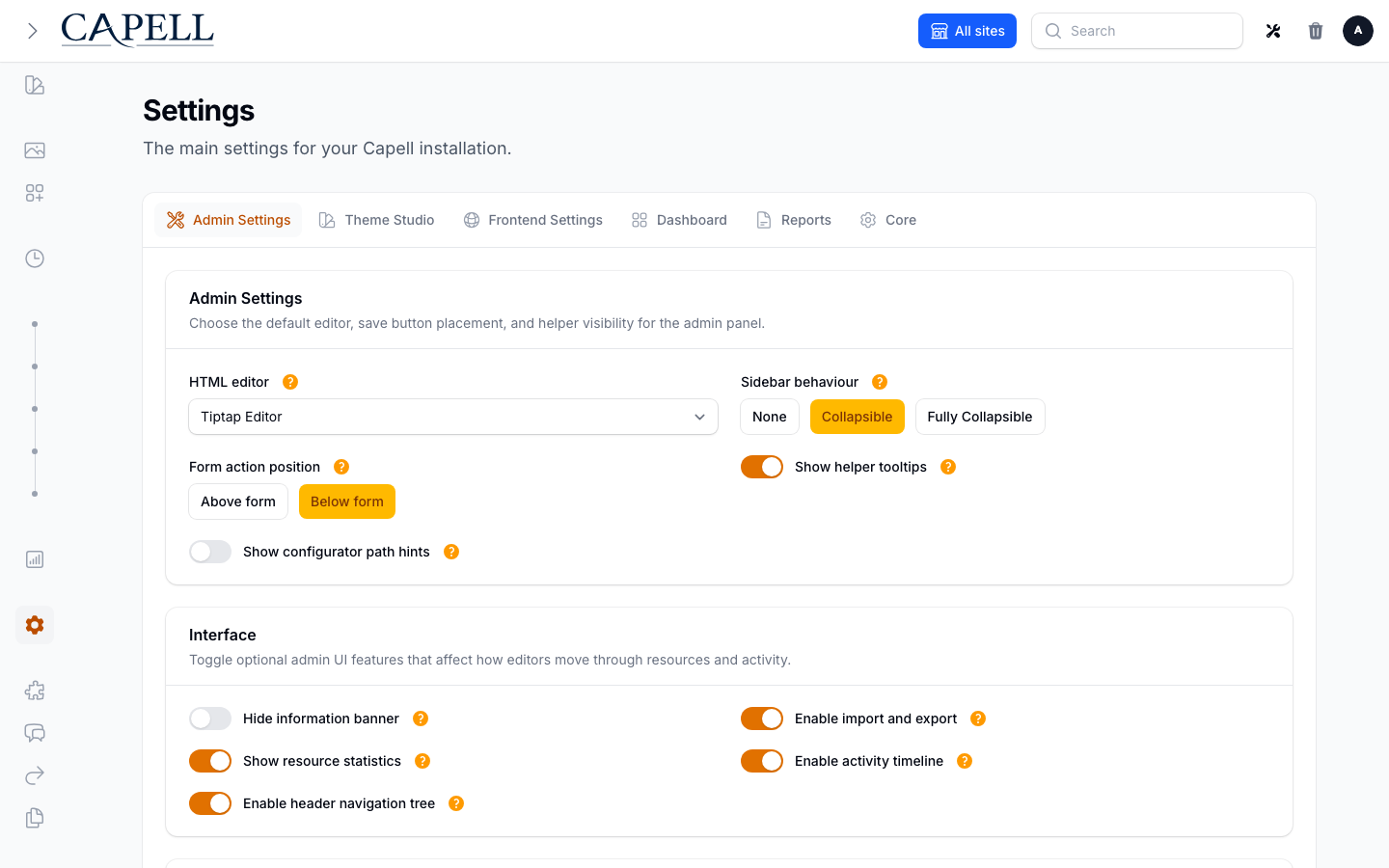
This is direct UI evidence for the settings contribution: the package registers a group and Admin renders it without the package editing the Settings page.
Provider Registration
Section titled “Provider Registration”<?php
declare(strict_types=1);
namespace Acme\AnnouncementBar\Providers;
use Acme\AnnouncementBar\Actions\ResolveAnnouncementBarAction;use Acme\AnnouncementBar\Admin\AnnouncementBarAdminBridge;use Acme\AnnouncementBar\Settings\AnnouncementBarSettings;use Capell\Admin\Facades\CapellAdmin;use Capell\Core\Support\Packages\AbstractPackageServiceProvider;use Capell\Core\Support\Settings\SettingsSchemaRegistry;use Capell\Frontend\Enums\RenderHookLocation;use Capell\Frontend\Support\Render\RenderHookRegistry;use Illuminate\Contracts\View\View;use Spatie\LaravelPackageTools\Package;
final class AnnouncementBarServiceProvider extends AbstractPackageServiceProvider{ public static string $name = 'announcement-bar';
public static string $packageName = 'acme/announcement-bar';
public function configurePackage(Package $package): void { $package ->name(self::$name) ->hasConfigFile('announcement-bar') // No hasMigration() call: settings migrations are published from // `database.settings` in capell.json, and hasMigration() is for // Laravel schema migrations only. ->hasViews('announcement-bar') ->hasTranslations(); }
protected function bootInstalledPackage(): self { $this->registerSettings(); $this->registerAdmin(); $this->registerFrontend();
return $this; }
private function registerSettings(): void { app(SettingsSchemaRegistry::class) ->registerSettingsClass('announcement-bar', AnnouncementBarSettings::class); }
private function registerAdmin(): void { CapellAdmin::registerAdminBridge(self::$packageName, AnnouncementBarAdminBridge::class); }
private function registerFrontend(): void { app(RenderHookRegistry::class)->registerCallable( RenderHookLocation::HeaderAfter, function (): View|string|null { $announcement = ResolveAnnouncementBarAction::run();
if (! $announcement->enabled || $announcement->message === '') { return null; }
return view('announcement-bar::frontend.banner', [ 'announcement' => $announcement, ]); }, ); }}bootInstalledPackage() — not spatie-package-tools’ packageBooted() — is where package registration belongs. AbstractPackageServiceProvider calls it only when the extension record is installed, which is what makes “required but not enabled” mean “renders nothing”. Registering in packageBooted() runs unconditionally, so a disabled package would still add its admin page and render hook.
The base class offers three boot hooks:
| Hook | Runs |
|---|---|
bootPackage() | Always, including during package:discover. Metadata only. |
bootInstalledPackage() | Only when the package is installed. Normal registration. |
bootWhenInstalled(callable) | Same gate, for one-off blocks. |
If a package has separate install/runtime/admin/frontend providers, keep provider buckets in capell.json aligned with those responsibilities. Do not register Filament resources from a frontend-only provider.
Pick a location that the theme actually emits. RenderHookLocation declares more cases than the shipped Foundation templates render. These are emitted today:
HeadClose, HeaderAfter, MainContent, BeforeContent, AfterContent, BeforeTitle, AfterTitle, BeforeResult, AfterResult, Footer, FooterBefore, FooterAfter, BodyEnd.
HeadOpen, BodyStart, HeaderBefore, and ArticleMeta are declared but have no emit site in the Foundation templates, so a hook registered there is silently never called. There is no post-render injector that would rescue it. This tutorial uses HeaderAfter to put the banner directly below the site header.
A custom or third-party theme may emit a different subset. If a hook does not appear, confirm the theme renders that location before debugging your provider — see Debugging public output.
Use registerView() for view-name hooks, registerInlineBlade() for inline Blade snippets, registerCallable() for closures that resolve hydrated state before rendering, and registerExtension() for class-based render hooks. Package-owned keyed hooks should use RenderHookContributionData::view(), inlineBlade(), or extension() when they need diagnostics, stable dedupe keys, and cache-safety metadata.
Admin Bridge
Section titled “Admin Bridge”<?php
declare(strict_types=1);
namespace Acme\AnnouncementBar\Admin;
use Acme\AnnouncementBar\Filament\Pages\AnnouncementBarSettingsPage;use Capell\Admin\Data\Bridges\AdminBridgeContextData;use Capell\Admin\Facades\CapellAdmin;use Capell\Admin\Support\Bridges\AbstractAdminBridge;use Capell\Admin\Support\Bridges\AdminBridgeRegistrar;
final class AnnouncementBarAdminBridge extends AbstractAdminBridge{ public function register(AdminBridgeRegistrar $registrar, AdminBridgeContextData $context): void { CapellAdmin::registerExtensionPage($context->packageName, AnnouncementBarSettingsPage::class); }}Extend AbstractAdminBridge rather than implementing the AdminBridge interface directly. The interface declares two methods — isEnabled(AdminBridgeContextData $context): bool and register(...) — so implementing it directly without isEnabled() is a fatal error. AbstractAdminBridge supplies isEnabled() returning true; override it when the bridge should register conditionally.
Note the namespace: the context object is Capell\Admin\Data\Bridges\AdminBridgeContextData, under Data\Bridges.
Use an AdminBridge when a package contributes more than one admin surface or needs a predictable package-owned registration point.
Public Blade
Section titled “Public Blade”@if ($announcement->enabled && $announcement->message !== '') <aside class="announcement-bar">{{ $announcement->message }}</aside>@endifThis view is intentionally boring. It renders public copy only. It must not include model IDs, field paths, admin URLs, authoring selectors, permissions, or package diagnostics.
Cache Invalidation
Section titled “Cache Invalidation”The banner renders on every page, so changing the setting must invalidate cached public HTML. Otherwise editors save a new message and the old one keeps being served.
CacheInvalidationRegistry::registerDependency(string $modelClass, string|array $cachePatterns) is keyed on an Eloquent model and driven by model saves, so it cannot be used here: this package owns no model. A settings-driven change needs an explicit flush instead.
Add an Action that flushes the frontend cache:
<?php
declare(strict_types=1);
namespace Acme\AnnouncementBar\Actions;
use Capell\Frontend\Data\CacheInvalidationPlanData;use Capell\Frontend\Data\CacheInvalidationRule;use Capell\Frontend\Support\Cache\CacheInvalidationExecutor;use Lorisleiva\Actions\Concerns\AsObject;
final class FlushAnnouncementBarCacheAction{    use AsObject;
    public function handle(): void    {        resolve(CacheInvalidationExecutor::class)->execute(            new CacheInvalidationPlanData([CacheInvalidationRule::flushFrontendTag()]),        );    }}
flushFrontendTag() clears the whole frontend cache. That is the honest choice for output that appears on every page; use the narrower forgetKey(), invalidatePattern(), or pageModel() rules when a change affects a known subset.
Nothing calls this Action automatically. It is wired in by the save() override on the settings page — that override is the only thing standing between an editor’s save and stale cached HTML.
Frontend cache classes come from capell-app/frontend. Guard the call (or move it behind an interface) if your package supports installations that do not include the Frontend package.
Do not build ad hoc cache keys in Blade.
Test Recipes
Section titled “Test Recipes”Provider Registration
Section titled “Provider Registration”use Capell\Admin\Support\Bridges\AdminBridgeRegistry;use Acme\AnnouncementBar\Admin\AnnouncementBarAdminBridge;use Capell\Core\Facades\CapellCore;
it('registers the admin bridge', function (): void { CapellCore::forcePackageInstalled('acme/announcement-bar');
expect(resolve(AdminBridgeRegistry::class)->classes('acme/announcement-bar')) ->toContain(AnnouncementBarAdminBridge::class);});The bridge registry is a container singleton, not a facade method: resolve AdminBridgeRegistry directly. classes() takes the package name and returns list<class-string<AdminBridge>> for that package only — it has no zero-argument form.
Frontend Output Safety
Section titled “Frontend Output Safety”it('renders only public announcement markup', function (): void { app(AnnouncementBarSettings::class)->fill([ 'enabled' => true, 'message' => 'Open weekend hours', ])->save();
$html = $this->get('/')->getContent();
expect($html)->toContain('Open weekend hours') ->not->toContain('filament') ->not->toContain('signed') ->not->toContain('field_path') ->not->toContain('data-capell-editor');});Action Boundary
Section titled “Action Boundary”it('returns disabled data when message is empty', function (): void { app(AnnouncementBarSettings::class)->fill([ 'enabled' => true, 'message' => ' ', ])->save();
$data = ResolveAnnouncementBarAction::run();
expect($data->enabled)->toBeTrue() ->and($data->message)->toBe('');});These recipes assume a working test harness. A package developed in its own repository needs Orchestra Testbench, a base TestCase that boots Capell, and a package-local phpunit.xml — see Testing packages → Standalone package harness for the exact files. Run them from the package root:
vendor/bin/pestInside this monorepo, run the narrow package suite against the root configuration instead:
vendor/bin/pest packages/announcement-bar/tests --configuration=phpunit.xmlInstall And Enable It
Section titled “Install And Enable It”Composer alone is not enough. Providers in the runtime, admin, and frontend buckets load only once the package’s extension record is enabled, so a package that is merely required renders nothing and shows no admin page.
From the application root:
composer require acme/announcement-barphp artisan capell:package-cache:clearphp artisan capell:package-cachephp artisan capell:extension-install acme/announcement-bar --dry-runphp artisan capell:extension-install acme/announcement-barcapell:extension-install publishes and runs this package’s settings migrations (because database.settings is true), runs any declared actions.install — this package declares none — and enables the extension. Run --dry-run first on a new package to see the plan without changing anything.
Site owners do the same thing from the admin Marketplace, which is why the lifecycle must be an Action and not a legacy command.
Then confirm the package is actually live:
- the package is listed on the admin Extensions page, and its settings page opens from there;
- enabling the toggle and saving a message renders the banner on a public page;
php artisan capell:doctorreports no package health failures.
Extension settings pages do not appear in the normal Settings navigation. registerExtensionPage() deliberately turns off the page’s native Filament navigation and registers it in the extension page registry instead, so the page is reached from the Extensions management list. This is intended behaviour, not a misconfiguration — do not add $shouldRegisterNavigation = true to force it into the sidebar. Operational pages intended as Site Health subpages implement Capell\Admin\Contracts\Diagnostics\SiteHealthSubpage, which explicitly preserves native navigation. Declare a page-owned protected static bool $shouldRegisterNavigation = true as well: an inherited property shares storage with ordinary extension pages whose navigation is suppressed. Set their navigation group to match SiteHealthPage, and use its navigation label as the parent only when the operator can access the overview; otherwise return no parent so the authorised page remains reachable.
If the package is not on the Extensions page at all, it is required but not enabled — rerun capell:extension-install. Extension troubleshooting covers the rest.
Release Checks
Section titled “Release Checks”- Package appears in
composer show acme/announcement-bar. capell.jsonvalidates and uses manifest version 3.php artisan capell:extension-audit packages/announcement-barpasses.- Provider registers package-owned settings, admin, frontend, and cache behavior only.
- Admin UI strings use translations.
- Public output passes anonymous and non-admin safety tests.
- README links to package docs, extension points, config, tests, and troubleshooting.