
Marketplace Extension Contracts
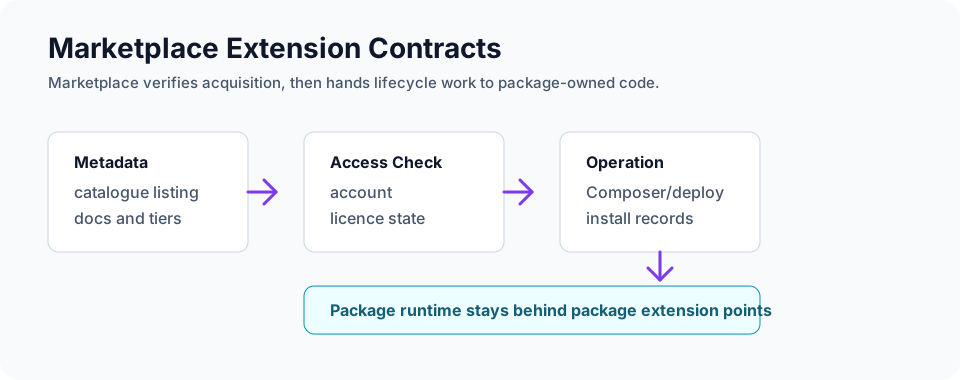
Use Marketplace-facing contracts when a package should appear in catalogue surfaces, participate in account/licence checks, or hand off installation to Composer/deployment operations. Marketplace proves acquisition and authorization; package runtime still belongs to the package and host extension points.
Config And Manifest Keys
Section titled “Config And Manifest Keys”Declare Marketplace-visible metadata in capell.json:
marketplacefor listing, documentation, access, and acquisition metadata.product.groupandproduct.tierfor catalogue grouping.dependencies.requiresfor hard package requirements.dependencies.supportsplusvisibility: supportfor support packages.providers.metadatafor safe metadata-only discovery.providers.installfor install operations available before enablement.providers.runtime,providers.admin, andproviders.frontendfor enabled package behavior.
Keep package docs and Marketplace metadata aligned with the generated extension catalogue. Do not describe optional package behavior as a built-in host feature.
Suites And Trials
Section titled “Suites And Trials”Suite and trial presentation is driven only by Marketplace server data. The client does not calculate entitlement or trial eligibility.
- A suite declares its stable group through
product.bundleand its installable members throughdependencies.requires. - The hosted quote must price every paid member individually and return one entitlement per priced member. The client reuses that basket; it must not infer a member entitlement from the suite label alone.
- Member prices must use the same currency before the client can show a sum-of-parts total or savings. Missing or mixed-currency prices suppress that comparison.
- Trial terms must be returned in
trialorcommercial.trial. The server owns availability, duration, checkout pricing, start and expiry semantics; the client only renders supplied terms and sends the selection through the hosted flow.
These are server-contract requirements. A client release must remain conservative when the fields are absent: no invented trial, price, saving, or entitlement.
Extension Points
Section titled “Extension Points”Marketplace-aware packages should use existing host contracts:
capell.jsonfor catalogue and install metadata.- Package install/uninstall Actions for lifecycle behavior.
- Settings schema registration for package configuration after install.
CapellAdmin::registerExtensionPage(...)for package-owned admin control pages.CacheInvalidationRegistry::registerDependency(...)when Marketplace-installed features render cached frontend output.
Marketplace callbacks and operation records should not reach into package internals. They should authorize, record, and hand off to Composer/deployment or package lifecycle Actions.
Testing
Section titled “Testing”Test Marketplace integration with real package metadata:
- Manifest tests assert Marketplace fields and provider buckets.
- Catalogue/action tests prove listing state, access state, and install operation data.
- Lifecycle tests prove install and uninstall Actions can run through package operation flow.
- Public rendering tests are required if the package outputs frontend HTML.
For host Marketplace changes, start narrow:
vendor/bin/pest packages/marketplace/tests --configuration=phpunit.xmlUse php artisan marketplace:qa:extensions-lifecycle --dry-run --only=vendor/package in a consuming app when validating a real package catalogue entry.