
Demo Kit
Package docs status
Section titled “Package docs status”This page is generated from package source documentation in the Capell packages repository and the checked-in manifest. Source documentation is not distribution status. Before running a Composer command, verify that the exact package and compatible 1.x release are available through public Packagist or the authenticated marketplace account.
| Field | Value |
|---|---|
| Composer package | capell-app/demo-kit |
| Package slug | demo-kit |
| Product group | Capell Foundation |
| Tier | free |
| Bundle | foundation |
| Runtime contexts | admin, frontend, console |
| Capell version | ^1.0 |
| Catalogue role | extension |
| Release channel | Beta |
| Source repository | capell-app/packages |
| Source path | packages/demo-kit |
| Docs source | packages/demo-kit/docs |
| Manifest | capell.json |
What This Plugin Adds
Section titled “What This Plugin Adds”Demo Kit is an Available, Schema-owning Capell package in the Capell Foundation product group. It ships as capell-app/demo-kit and extends these surfaces: admin, frontend, console.
Demo Kit creates deterministic demo users, sites, languages, pages, media, and package examples from a repeatable generation plan.
Administrators can start demo generation from a package page or console command, then inspect the generated pages and components on the frontend.
Status details:
- Status: Available
- Tier: free
- Bundle: foundation
- Composer package:
capell-app/demo-kit - Namespace:
Capell\DemoKit - Theme key: not applicable
Why It Matters
Section titled “Why It Matters”For developers: Typed generation plans and package demo command orchestration make local setup, screenshots, and QA data reproducible from a chosen seed.
For teams: Teams can evaluate a populated site before entering real content and reset the sample state between demos, with explicit guards against production seeding.
Screens And Workflow
Section titled “Screens And Workflow”Screenshot contract: docs/screenshots.json.
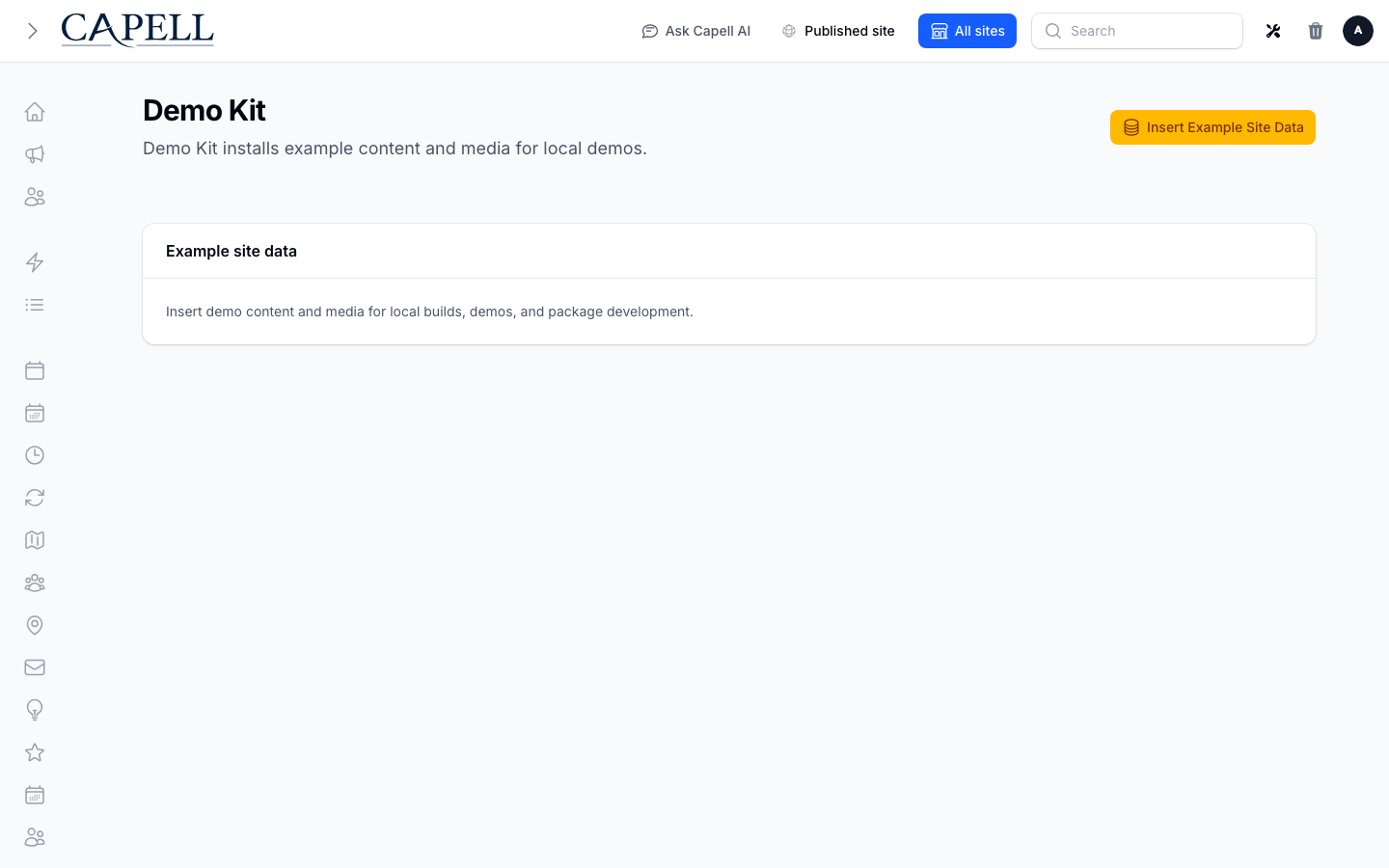
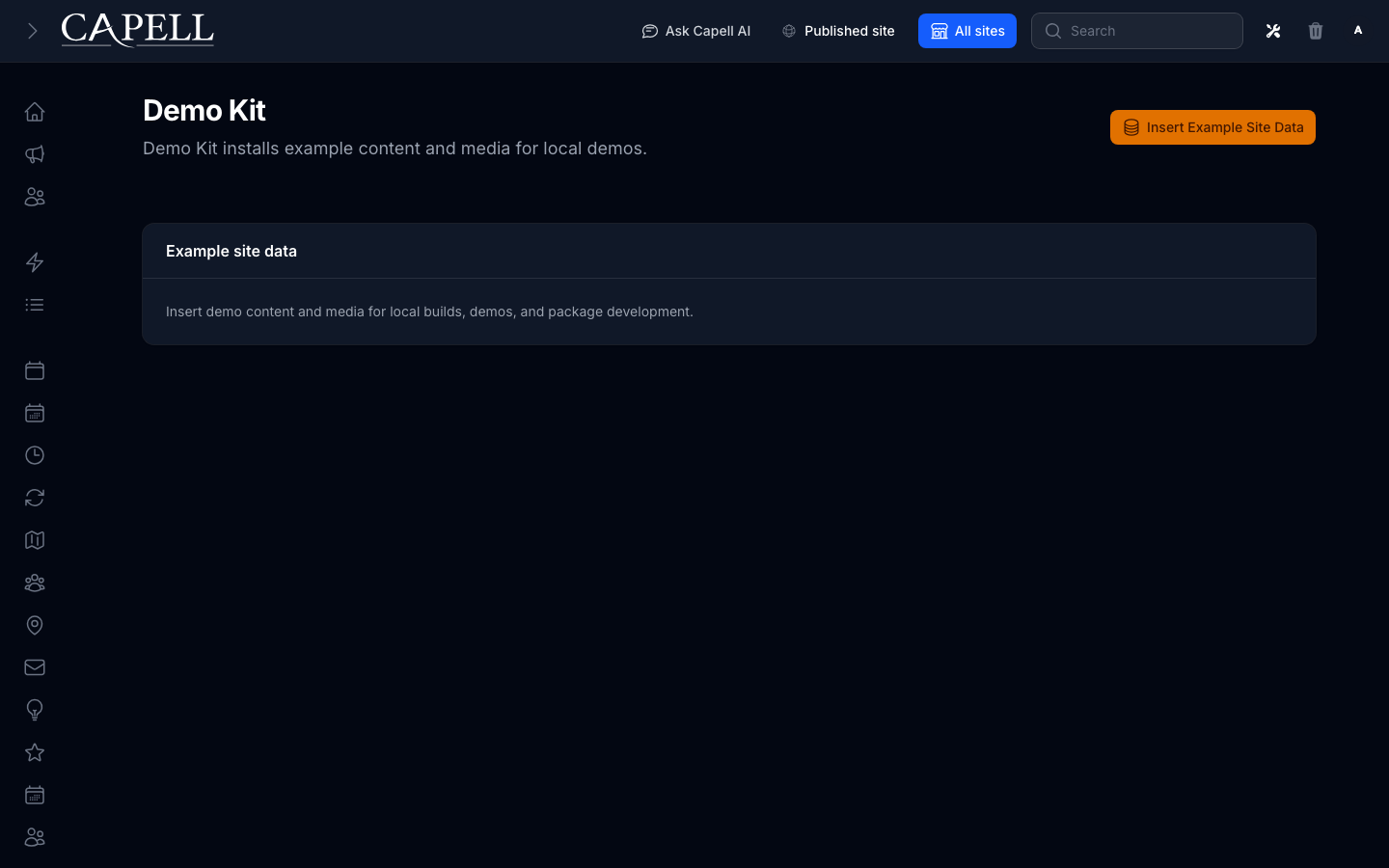
- Demo Kit ready to plan (admin, required evidence).
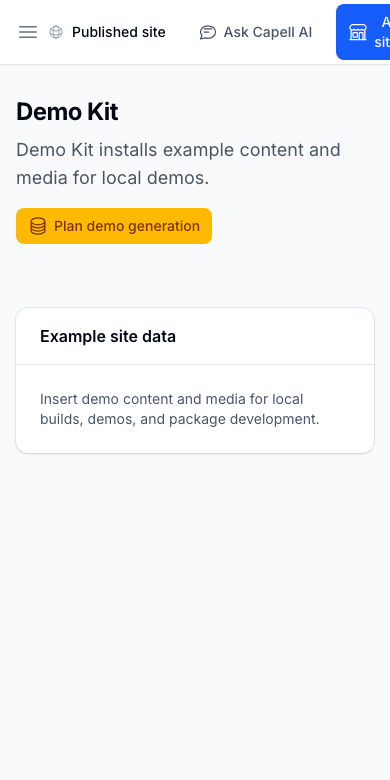
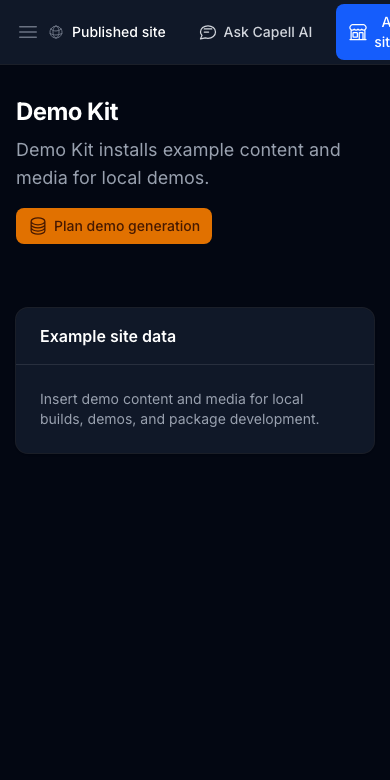
- Demo Kit ready to plan on mobile (admin, required evidence).
- Recommended generation profile (admin, required evidence).
- Recommended generation profile on mobile (admin, required evidence).
- Custom generation profile (admin, required evidence).
- Custom generation profile on mobile (admin, required evidence).
- Generation review before confirmation (admin, required evidence).
- Generation review before confirmation on mobile (admin, required evidence).
- Review of reusable generated sites (admin, required evidence).
- Review of reusable generated sites on mobile (admin, required evidence).
- Review blocked by ordinary content (admin, required evidence).
- Review blocked by ordinary content on mobile (admin, required evidence).
- Explicit generation confirmation (admin, required evidence).
- Explicit generation confirmation on mobile (admin, required evidence).
- Queued generation (admin, required evidence).
- Queued generation on mobile (admin, required evidence).
- Running generation (admin, required evidence).
- Running generation on mobile (admin, required evidence).
- Completed generation and created content (admin, required evidence).
- Completed generation and created content on mobile (admin, required evidence).
- Failed generation with redacted error (admin, required evidence).
- Failed generation with redacted error on mobile (admin, required evidence).
- Stalled generation requiring a new review (admin, required evidence).
- Stalled generation requiring a new review on mobile (admin, required evidence).
- Provenance-only reset confirmation (admin, required evidence).
- Provenance-only reset confirmation on mobile (admin, required evidence).
- Demo Kit with navigation open (admin, required evidence).
- Demo Kit with navigation open on mobile (admin, required evidence).
- Insights consent priming capture (frontend, supplementary evidence).
- Generated demo page content widget (frontend, required evidence).
- Generated homepage section widget (frontend, required evidence).
Technical Shape
Section titled “Technical Shape”Service providers
Section titled “Service providers”Capell\DemoKit\Providers\DemoKitServiceProviderCapell\DemoKit\Providers\ConsoleServiceProvider
Config files
Section titled “Config files”packages/demo-kit/config/capell-demo-kit.php
Migrations
Section titled “Migrations”packages/demo-kit/database/migrations/2026_07_19_130000_create_demo_kit_generation_runs_table.phppackages/demo-kit/database/migrations/2026_09_08_120000_add_review_data_to_demo_kit_generation_runs_table.php
Models
Section titled “Models”DemoKitGenerationRun
Filament classes
Section titled “Filament classes”HomepageSectionWidgetConfiguratorDemoKitPage
Livewire components
Section titled “Livewire components”KitchenSinkStressWidgetResourcesLibrary
Actions
Section titled “Actions”BuildDemoGenerationPlanActionBuildDemoGenerationReviewActionBuildDemoPageContentViewDataActionBuildKitchenSinkLayoutWidgetEntriesActionConfigureKitchenSinkReferenceWidgetsActionCreateDemoLanguagesActionCreateDemoSiteActionCreateDemoUsersActionCreateKitchenSinkContextPagesActionCreateKitchenSinkSourceWidgetsActionCreateKitchenSinkVariantWidgetsActionAssertDefaultDemoInstallHealthActionDemoInstallHealthDataDummyContentGeneratorActionHasDemoSiteProvenanceActionInsertExampleSiteDataActionInstallKitchenSinkDemoPageActionListDemoKitProvenanceSitesActionMarkDemoSiteProvenanceActionPrepareDemoKitScreenshotFixtureActionQueueDemoKitGenerationActionReclaimStalledDemoKitGenerationRunsActionRedactDemoKitErrorMessageActionRefreshDemoStitchPagesActionResetDemoKitProvenanceActionResetDemoSitesActionRestoreDemoKitScreenshotFixtureActionSyncKitchenSinkPageAssetsAction
Data objects
Section titled “Data objects”DemoGenerationPlanDataDemoGenerationReviewDataDemoKitScreenshotFixtureDataDemoPageContentViewDataDemoPagePlanDataDemoProfileDataDemoSiteGenerationPlanData
RunDemoKitGenerationJob
Command signatures
Section titled “Command signatures”capell:demo-kit-doctorcapell:demo-kit-full-demo
Console command classes
Section titled “Console command classes”AdminDemoCommandGuardsAgainstProductionHasLanguagesOptionHasSitesOptionDemoCommandDemoKitDoctorCommandDemoKitScreenshotFixtureCommandFullDemoCommandKitchenSinkDemoCommandRefreshDemoStitchPagesCommand
Manifest contributions
Section titled “Manifest contributions”admin-page: Capell\DemoKit\Manifest\DemoKitAdminPageContributionasset: Capell\DemoKit\Manifest\DemoKitAssetsContributionconfigurator: Capell\DemoKit\Manifest\DemoKitConfiguratorContributionconsole-command: Capell\DemoKit\Manifest\DemoKitConsoleCommandsContributiondashboard-widget: Capell\DemoKit\Manifest\DemoKitRenderablesContributionfrontend-component: Capell\DemoKit\Manifest\DemoKitFrontendComponentsContributionhealth-check: Capell\DemoKit\Health\DemoKitHealthCheck
Health checks
Section titled “Health checks”Capell\DemoKit\Health\DemoKitHealthCheck
Blade views
Section titled “Blade views”packages/demo-kit/resources/views/components/widget/demo-page-content-assets.blade.phppackages/demo-kit/resources/views/components/widget/demo-page-content.blade.phppackages/demo-kit/resources/views/components/widget/homepage-section.blade.phppackages/demo-kit/resources/views/filament/pages/demo-kit.blade.phppackages/demo-kit/resources/views/livewire/kitchen-sink-stress-widget.blade.phppackages/demo-kit/resources/views/livewire/resources-library.blade.php
Cache tags
Section titled “Cache tags”demo-kit
Data Model
Section titled “Data Model”- Required tables:
capell_demo_kit_generation_runs. - Models:
DemoKitGenerationRun. - Migration files:
2026_07_19_130000_create_demo_kit_generation_runs_table.php,2026_09_08_120000_add_review_data_to_demo_kit_generation_runs_table.php. - Migration impact: run host migrations through the package install flow before opening package surfaces.
- Deletion/retention behaviour: Docs gap: migrations and manifest contributions do not prove a cascade, pruning command, or timed retention policy.
Install Impact
Section titled “Install Impact”- Required packages:
capell-app/admin,capell-app/core,capell-app/frontend,capell-app/layout-builder. - Admin navigation: declares
admin-page: DemoKitAdminPageContribution; each Filament page or resource controls its own navigation visibility. - Admin/editor extensions:
configurator: DemoKitConfiguratorContribution,dashboard-widget: DemoKitRenderablesContribution. - Permissions: Shield-generated page permissions for
Capell\DemoKit\Filament\Pages\DemoKitPage(names and grants depend on host Shield configuration). - Public routes: none declared.
- Database changes: package migrations are declared.
- Config:
config/capell-demo-kit.php. - Settings: no package settings declared.
- Queues or schedules: queue jobs
RunDemoKitGenerationJob. - Cache tags:
demo-kit. - Commands:
capell:demo-kit-doctor,capell:demo-kit-full-demo.
Common Pitfalls
Section titled “Common Pitfalls”- Keep required Capell packages on compatible v4 releases:
capell-app/admin,capell-app/core,capell-app/frontend,capell-app/layout-builder. - Run migrations before opening package resources or public routes.
- Review package configuration before production-like verification:
config/capell-demo-kit.php. - Keep public Blade and cached HTML free of authoring markers, model IDs, permissions, signed editor URLs, and lazy database queries.
- Custom write integrations must preserve invalidation for
demo-kitcache tags.
Troubleshooting
Section titled “Troubleshooting”| Symptom | Likely cause | Check | Fix |
|---|---|---|---|
| Package health check reports a problem | Package configuration or runtime dependencies are not ready | Run php artisan capell:demo-kit-doctor | Follow the reported checks, then rerun the doctor command |
| Package surface is missing after install | Provider or manifest is not loaded | Confirm capell.json, package composer.json, and provider registration | Reinstall the package, refresh Composer autoload, and clear host caches |
| Admin screen or command fails on missing table | Package migrations have not run | Check the tables listed in Data Model | Run host migrations and rerun the focused package test |
| Background work does not run | Queue worker or declared schedule is not active | Check the jobs and scheduled commands listed in Technical Shape | Start the queue worker or host scheduler, then run the focused command or package test |
| Public output leaks unexpected state | Render data, cache variation, or authoring boundary has regressed | Check public Blade, cache tags, and public-output safety tests | Move data loading out of Blade and rerun the package public-output tests |
Quick Start
Section titled “Quick Start”- Install the package:
composer require capell-app/demo-kit. - See it working: run
php artisan capell:demo-kit-full-demo. - Open the package admin surface at
/admin/demo-kitand confirm Demo Kit is available.