
Capell Marketplace
Package docs status
Section titled “Package docs status”This page is generated from package source documentation in the Capell foundation repository and the checked-in manifest. Source documentation is not distribution status. Before running a Composer command, verify that the exact package and compatible 1.x release are available through public Packagist or the authenticated marketplace account.
| Field | Value |
|---|---|
| Composer package | capell-app/marketplace |
| Package slug | marketplace |
| Product group | Capell Foundation |
| Tier | free |
| Bundle | foundation |
| Runtime contexts | admin, console |
| Capell version | ^1.0 |
| Catalogue role | core |
| Release channel | Released |
| Source repository | capell-app/capell |
| Source path | packages/marketplace |
| Docs source | packages/marketplace/docs |
| Manifest | capell.json |
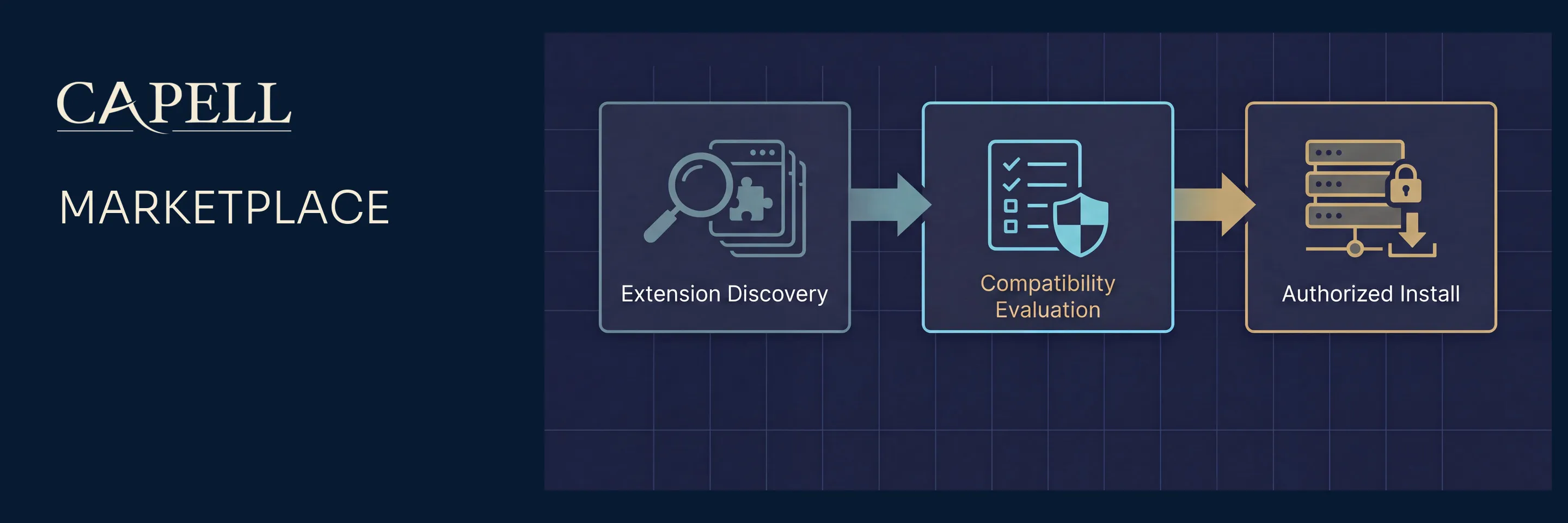





capell-app/marketplace connects a Capell installation to the Capell extension marketplace. It owns catalogue browsing, Capell account linking, heartbeat/update advisory state, account-based Marketplace install eligibility decisions, queued local Composer install operations, free-install telemetry, and signed install/upgrade authorization records for protected extensions.
Use this package when an admin needs to discover, authorize, or maintain extensions from the Capell marketplace. Local enable, disable, uninstall, and bulk extension management remain part of the installed Extensions surface.
Package Boundary
Section titled “Package Boundary”Marketplace owns:
- the Extensions-page Marketplace action, extension browser, extension detail flow, account connection action, heartbeat action, and install attempt ledger
- signed Marketplace client requests, account connection callbacks, catalogue caching, heartbeat snapshots, update notices, advisory dismissals, registration sessions, install attempts, queued local Composer operations, and queued free-install telemetry
- Marketplace permissions for viewing extension and Marketplace surfaces
Marketplace does not own:
- Core package registry internals or generic package cache behavior
- Admin’s installed Extensions table and local extension management actions
- production deployment completion after a Composer change has been published by Deployments
- public frontend rendering or theme output
Install
Section titled “Install”composer require capell-app/marketplaceThe package is enabled by default. Main config values:
| Env var | Purpose |
|---|---|
CAPELL_MARKETPLACE_ENABLED | Enable Marketplace integration. |
CAPELL_INSTANCE_ID | Existing Marketplace instance ID fallback. |
CAPELL_MARKETPLACE_URL | Marketplace API base URL. Defaults to https://capell.app/api/v1. |
CAPELL_MARKETPLACE_WEB_URL | Public web URL for purchase and account flows. |
CAPELL_MARKETPLACE_CATALOGUE_PAGE_LIMIT | Maximum catalogue pages fetched for the browser listing. |
CAPELL_MARKETPLACE_WEBHOOK_URL | Public callback URL used by Capell App when APP_URL is not enough. |
CAPELL_MARKETPLACE_WEBHOOK_SECRET | Fallback signing secret for configured instances. |
CAPELL_MARKETPLACE_TROUBLESHOOTING_URL | Help URL shown from Marketplace heartbeat failures. |
Only override CAPELL_MARKETPLACE_URL for staging or self-hosted Marketplace APIs. The active public API path is versioned with /api/v1.
Runtime Surfaces
Section titled “Runtime Surfaces”- Provider:
Capell\Marketplace\Providers\MarketplaceServiceProvider - Config:
config/capell-marketplace.php - Routes:
routes/marketplace.php - Marketplace client:
Capell\Marketplace\Services\MarketplaceClient - Main Filament surfaces:
MarketplaceExtensionDetailPage,MarketplacePackageOperationsPage,MarketplaceExtensionsBrowser, marketplace actions on the installed Extensions page, connection status actions, and the extension health widget - Admin extenders:
MarketplaceExtensionsPageExtendertagged asExtensionsPageExtender::TAG;ThemeMarketplaceHeaderActionExtendertagged asResourceHeaderActionExtender::TAG - Header action registry keys:
capell-marketplace.open-marketplace,capell-marketplace.connect-account - Livewire aliases:
capell-marketplace.marketplace-extensions-browserandcapell-marketplace::marketplace-extensions-browser - Entitlements binding:
MarketplaceExtensionEntitlementsimplements Core’sCapell\Core\Contracts\Marketplace\ExtensionEntitlementsfor signed licence decisions and installed-receipt verification - Main actions/jobs:
StartMarketplaceAccountConnectionAction,CompleteMarketplaceAccountConnectionAction,PhoneHomeAction,CheckForUpdatesAction,InstallMarketplaceExtensionAction,CreateExtensionAcquisitionAction,CreateMarketplaceInstallAttemptAction,TransitionMarketplaceInstallAttemptAction,QueueMarketplaceInstallAttemptAction,RunMarketplaceInstallAttemptJob,CancelMarketplaceInstallAttemptAction,RecordThemeInstallIntentAction,ResolvePendingThemeInstallsAction,VerifyMarketplaceSignedActivationAction.RecordMarketplaceInstallAttemptActionremains a deprecated 1.x compatibility adapter.
The account connection callback is authenticated under the configured admin path.
How The Main Flows Work
Section titled “How The Main Flows Work”| Flow | Classes | Notes |
|---|---|---|
| Account connection | StartMarketplaceAccountConnectionAction, CompleteMarketplaceAccountConnectionAction, MarketplaceAccountConnectionCallbackController | Creates a short-lived account connection session, redirects the admin to Capell App, validates the returned state/code, requires a verified account email, stores account identity in marketplace_instances, returns to Extensions, and opens the Marketplace setup cockpit. |
| Catalogue browsing | MarketplaceClient, MarketplaceExtensionsBrowser, MarketplaceCatalogueTable, BuildMarketplaceSelectionReviewAction | Fetches JSON catalogue pages from /extensions, scopes cache keys by query and connection context, hides already installed extensions by default with a ternary installed-status filter, serves stale cache only when the browser explicitly allows it, and builds dependency-aware multi-extension review through typed selection policy data. |
| Install authorization | InstallMarketplaceExtensionAction, MarketplaceInstallEligibilityData, CreateExtensionAcquisitionAction, MarketplaceInstallActionPresenter | Orchestrates install lookup, selected options, eligibility, purchase/blocked handling, attempt recording, theme intent recording, free telemetry, local Composer queueing, notification handoff, and Deployments handoff status. |
| Package operations | CreateMarketplaceInstallAttemptAction, TransitionMarketplaceInstallAttemptAction, ClaimMarketplaceInstallDeploymentPublicationAction, RecordMarketplaceInstallDeploymentAction, DispatchMarketplaceInstallAttemptAction, FinalizeMarketplaceInstallAttemptAction, QueueMarketplaceInstallAttemptAction, RunMarketplaceInstallAttemptJob, CancelMarketplaceInstallAttemptAction, RetryMarketplaceInstallAttemptAction | Creates attempts through typed Data, enforces row-locked lifecycle transitions and finalization, claims deployment publication before remote work, records deployment evidence/classification/timeline state atomically, orders cancellation against job dispatch under the row lock, runs one local Composer operation at a time, exposes the dedicated Package Operations page, and emails Package Operations subscribers when manual attention is needed. |
| Theme install resolution | RecordThemeInstallIntentAction, ResolvePendingThemeInstallsAction | Records pending theme install choices and resolves them when the Composer package is present. |
| Heartbeat/update checks | PhoneHomeAction, CheckForUpdatesAction, RecordUpdateAdvisorySnapshotAction | Sends installed package snapshots and stores update/advisory results locally. |
Extension detail pages include a collapsed manual install option for hosts where queued Composer is not appropriate. Revealing it shows the package-specific composer require command followed by php artisan capell:extension-install <composer-name>.
Account Trust Flow
Section titled “Account Trust Flow”Account linking is the trust path for protected extensions. An admin connects a Capell account, approves the connection in Capell App, returns to /admin/extensions, and the Extensions page opens the Marketplace setup cockpit for install readiness. Free extensions do not require a connected account.
Data And Security
Section titled “Data And Security”Marketplace is schema-owning. Its current tables are marketplace_instances, marketplace_update_advisory_snapshots, marketplace_update_notice_dismissals, marketplace_account_connection_sessions, marketplace_install_flow_sessions, marketplace_install_attempts, the append-only marketplace_install_attempt_events timeline, and legacy marketplace_install_intents. Older installations may retain legacy domain tables, but this package no longer reads them for install access.
The package stores Marketplace instance IDs and encrypted signing secrets. Authorization requests are signed before they are sent to Capell App. Do not expose instance credentials, signing secrets, or licence keys in public output or unauthenticated admin copy.
Signed authorization proves Marketplace entitlement and request integrity. It does not make a package’s runtime code, screenshots, docs, or public/admin output inherently safe. Treat marketplace metadata as remote product data and treat installed extension code as normal executable application code.
Catalogue responses are cached for a short period. The cache is scoped by query and Marketplace account context so connected-account state can affect visible actions without leaking one installation’s state to another. The browser also checks local active install attempts so duplicate install actions for the same Composer package are blocked while an operation is queued, running, or cancellation is pending.
Grouped selection policy lives in BuildMarketplaceSelectionReviewAction, not the Livewire browser. It preserves explicit selection order, expands transitive dependencies once even when dependency graphs cycle, and returns stable failure reason codes through typed selection Data. Livewire remains responsible for authorization, translating those codes, notifications, redirects, and rendering.
Marketplace install operations are tracked in marketplace_install_attempts, with detailed timeline rows in marketplace_install_attempt_events. New attempts are created from MarketplaceInstallAttemptData. Lifecycle changes use MarketplaceInstallAttemptTransitionData and a transaction with a row lock. The allowed graph is queued to running, failed, or cancelled; running to succeeded, failed, timed out, or cancellation requested; and cancellation requested to cancelled or failed. Terminal lifecycle state is immutable and retries create one serialized queued row. Starting an install runs preflight checks, queues composer require --no-interaction --prefer-dist --with-all-dependencies only when preflight passes, claims the deployment-publication phase before invoking a configured publisher, and records safe output/error excerpts. Cancellation that commits before the claim prevents remote publication. Deployment results, classification, and timeline evidence commit together; a cancellation that wins after publication is claimed still retains the returned remote reference without dispatching local install work. Failed preflight checks retain supplied audit metadata and are stored as failed attempts so admins can inspect them.
Active and attention-needed operations are opened from the Extensions page header action, which deep-links to the dedicated Package Operations page and shows a badge while operations exist. Free/local Marketplace installs also redirect there immediately after queueing, with the queued operation selected so the admin can watch progress instead of staying in the Marketplace browser. The dashboard alert stays a compact summary. The Package Operations page owns filtering, operation details, timeline review, retry, cancel, mark resolved, and redacted diagnostic export. Cancelling a queued operation prevents Composer from running; cancelling a running operation normally lets Composer finish and then skips lifecycle work. If cancellation arrives after lifecycle work has already completed, finalization records non-retryable manual-attention evidence instead of reporting success or automatically reinstalling the package. Retry creates a new attempt linked to the failed source row, preserving the ledger. Package Operations notifications default to super admins and can be managed through notification preferences.
Verification
Section titled “Verification”From the split repository root, with development dependencies installed, run Marketplace package tests after changing account connection, catalogue, heartbeat, permission, telemetry, or install authorization behavior:
vendor/bin/pest testsRun focused action or HTTP tests first when changing a specific flow, for example:
vendor/bin/pest tests/Feature/Actions/MarketplaceAccountConnectionActionTest.php --configuration=phpunit.xmlvendor/bin/pest tests/Feature/Http/MarketplaceAccountConnectionCallbackControllerTest.php --configuration=phpunit.xmlRequirements And Support Policy
Section titled “Requirements And Support Policy”| Surface | Supported versions |
|---|---|
| PHP | ^8.4 |
| Laravel | ^13.0 |
| Core | The same release as this package |
| Admin | The same release as this package |
Each Capell 1.x minor receives security fixes for 24 months from its release date, and the latest 1.x minor is always supported. Upgrade all installed Capell foundation packages together to the same supported release before requesting a fix. See the Capell security policy for vulnerability reporting.
Support covers the dependency ranges above. When an upstream release reaches its own end of life earlier, upgrading that dependency may be required to receive a safe fix.
Troubleshooting
Section titled “Troubleshooting”| Symptom | Check | Fix |
|---|---|---|
| Marketplace API route errors | php artisan config:show capell-marketplace.marketplace.base_url | Use https://capell.app/api/v1 and run php artisan config:clear. |
| Connect account fails immediately | php artisan config:show app.url and the latest marketplace_account_connection_sessions.last_error | Set APP_URL to a URL with a host, clear config cache, and retry before the 10-minute session expires. |
| Account callback says the session or state is invalid | Latest row in marketplace_account_connection_sessions | Retry from the same browser tab. Do not reuse old approval URLs after starting a newer connection. |
| Catalogue loads but install is blocked | Marketplace detail response install_eligibility, authorization response, and connected account state | Resolve the Marketplace-provided account, email verification, entitlement, purchase, activation, or compatibility requirement, then request authorization again. |
| Install is queued or running for the same package | Package Operations page or marketplace_install_attempts.status | Wait for completion or cancel from Package Operations. |
| Preflight fails before Composer starts | Package Operations timeline and failure_stage = preflight | Fix the reported PHP, Composer, writeability, duplicate install, or queue readiness issue, then retry from Package Operations. |
| Local Composer install fails or times out | Package Operations notification, failure_type, timeline, failure_reason, output_excerpt, and error_excerpt | Fix the Composer/runtime issue, confirm whether files were partially installed, then retry from Package Operations. If web-triggered Composer is unavailable on the host, run the recorded command in deployment, then run php artisan package:discover, php artisan capell:extension-install <composer-name>, and php artisan optimize:clear. |
| Deployments publishing fails | Attempt deployment.status and Package Operations notification | Fix Deployments configuration or publish the Composer change manually; the local Composer install still runs unless the operation is cancelled. |
| Deployments is not connected | Attempt deployment.status | No manual action is shown by default; connect Deployments if this installation should publish Composer changes to a deployment source. |
| Heartbeat/update check fails | The RunMarketplaceHeartbeatAction::run() failure message or admin notification copy | Set APP_URL or CAPELL_MARKETPLACE_WEBHOOK_URL, confirm an instance exists, and check network access to the API URL. |
| Catalogue looks stale | Cache keys beginning capell-marketplace.marketplace.* | Run php artisan cache:clear locally, or use the browser refresh action when available. |
| Marketplace surfaces disappear | CAPELL_MARKETPLACE_ENABLED and php artisan optimize:clear | Re-enable the package config and clear cached config/routes. |
Development
Section titled “Development”Package development and coordinated verification happen in the capell-app/capell monorepo. Split package repositories are release mirrors; use docs.capell.app for cross-package guidance. See the contribution guide, security policy, and licence.
Further Reading
Section titled “Further Reading”| Page | Covers |
|---|---|
| Marketplace overview | Marketplace responsibilities, admin flow, account linking, and install access. |
The complete Marketplace operations and package-authoring guides are published at docs.capell.app.