
Capell Frontend
Package docs status
Section titled “Package docs status”This page is generated from package source documentation in the Capell foundation repository and the checked-in manifest. Source documentation is not distribution status. Before running a Composer command, verify that the exact package and compatible 1.x release are available through public Packagist or the authenticated marketplace account.
| Field | Value |
|---|---|
| Composer package | capell-app/frontend |
| Package slug | frontend |
| Product group | Capell Foundation |
| Tier | free |
| Bundle | foundation |
| Runtime contexts | frontend, console |
| Capell version | ^1.0 |
| Catalogue role | core |
| Release channel | Released |
| Source repository | capell-app/capell |
| Source path | packages/frontend |
| Docs source | packages/frontend/docs |
| Manifest | capell.json |
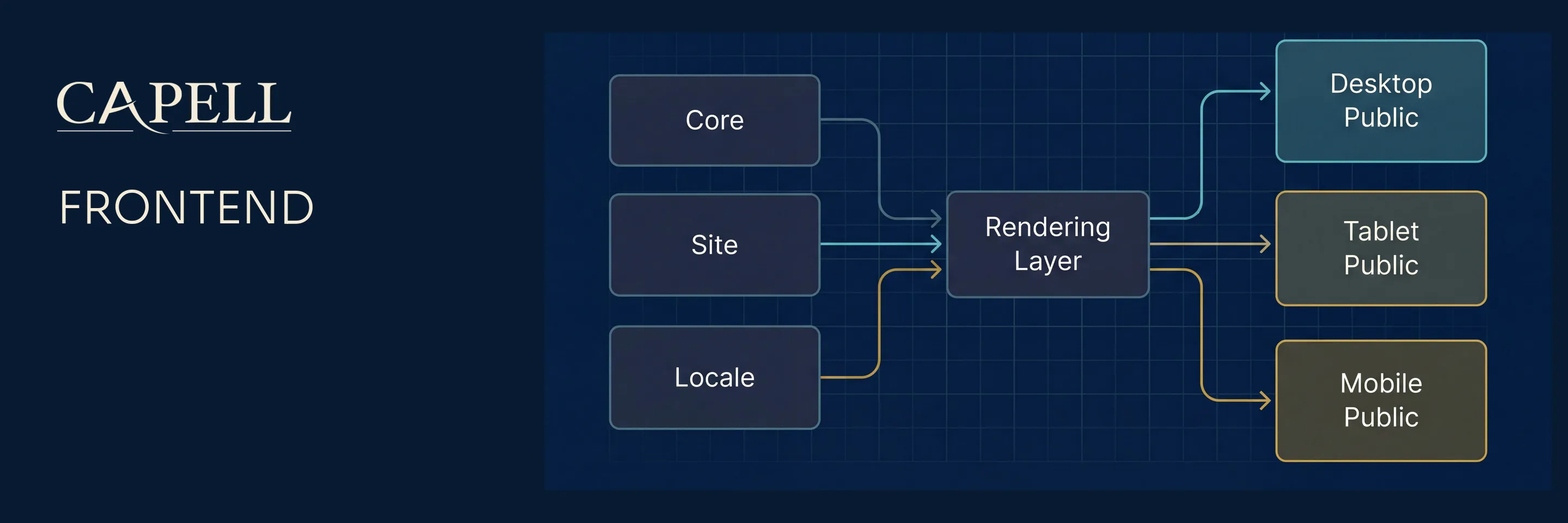





capell-app/frontend is the public rendering package for Capell CMS. It resolves Core page, site, language, layout, and theme records into Laravel responses and exposes the frontend extension points used by themes and frontend add-ons.
Use this package when a Capell install needs public page routing. It owns the minimal built-in default theme fallback, but richer visual themes and in-page authoring remain optional add-ons.
Package Boundary
Section titled “Package Boundary”Frontend owns:
- public page routes, frontend middleware, context resolution, page rendering actions, frontend settings, and page-view/cache integration hooks
- Blade components, Livewire page integration, render hooks, frontend asset manifests, Tailwind source aggregation, and cache invalidation registries
- the built-in
defaultBlade theme fallback and its static navigation, content, listing, CTA, and footer views - frontend install, after-install, upgrade, static HTML generation, and public render performance reporting commands
Frontend does not own:
- editor UI, settings pages, or admin dashboards; those are Admin surfaces
- opinionated theme demos, interactive widgets, carousels, lightboxes, or vertical-specific templates; those belong in optional theme/widget packages
- generated static HTML cache packages; those are optional cache packages layered on top
- in-page authoring controls; those must load after page load from an authenticated admin-only beacon package
Install
Section titled “Install”Frontend depends on capell-app/core and is optional — omit it for headless setups. The recommended path is the installer (composer require capell-app/installer → php artisan capell:install), which adds Frontend when you select it. To add it manually to an existing Capell app:
composer require capell-app/frontendphp artisan capell:frontend-installphp artisan capell:frontend-after-installFor Vite development builds, both install commands accept --dev.
On existing apps, use:
php artisan capell:frontend-upgradePublic routing depends on the host app’s web server sending unmatched public page requests to Laravel. See the server configuration docs before debugging route fall-through issues.
Runtime Surfaces
Section titled “Runtime Surfaces”- Provider:
Capell\Frontend\Providers\FrontendServiceProvider - Config:
config/capell-frontend.php - Routes:
routes/web.php - Controller:
Capell\Frontend\Http\Controllers\PageController - Middleware aliases:
frontend.resolve,frontend.etag,frontend.asset-optimization,frontend.anonymous_cacheable_render,frontend.rendering_strategy,frontend.maintenance,workspace.context - Main commands:
capell:frontend-install,capell:frontend-after-install,capell:frontend-upgrade,capell:generate-html - Main extension registries:
RenderHookRegistry,FrontendResourceRegistry,CacheInvalidationRegistry,ReservedFrontendPathRegistry,FrontendRouteMiddlewareRegistry,FrontendComponentRegistry,FrontendRuleConditionRegistry,FrontendResponseRendererRegistry,TailwindAssetsRegistry
The package always registers index.php and a fallback page route. / is only registered when CAPELL_FRONTEND_REGISTER_HOME_ROUTE=true. Reserved paths prevent internal or package-owned routes from falling through to public theme rendering.
Public Output Safety
Section titled “Public Output Safety”Public frontend responses must not expose admin/editor implementation details. Blade views, cached HTML, theme output, and public assets should not include authoring JavaScript, editable markers, model IDs, field paths, package names, signed editor URLs, or permission hints.
Frontend authoring must be a post-load admin feature. The public page loads as ordinary HTML; only an authenticated admin beacon response may add edit controls.
When changing public rendering, cache behavior, themes, or beacon integration, keep or add tests that prove anonymous and non-admin responses contain no authoring surface.

The public boundary is a conceptual contract, not a runtime screenshot. Read the canonical Mermaid source and public HTML safety contract alongside the renderer code.
Public assertions reject violations by throwing. Optional HTML Cache separately decides whether a response is eligible for shared caching or requires a private, no-store bypass. Admin preview and optional post-load authoring remain separate paths; the diagram is not runtime safety evidence.
Editor-authored rich text must cross a SafeHtml boundary before Blade renders it. Build the value with SafeHtml::sanitize($html, $sanitizer) (or use RenderHtmlContentAction) and output it with normal escaped Blade braces: {{ $safeHtml }}. The constructor is private so an arbitrary string cannot be mislabeled as safe HTML.
Data And Cache Behavior
Section titled “Data And Cache Behavior”Frontend reads Core records and owns frontend settings. Its main persistence impact is settings state; generated page cache files are owned by optional cache/static packages.
The capell:generate-html command writes static artifact metadata to storage/framework/capell-static-artifacts by default. Set CAPELL_FRONTEND_STATIC_ARTIFACTS_PATH when a deployment needs those artifacts written to a separate writable directory.
Cache invalidation is model-event aware and can run through queues depending on package configuration. If async invalidation is enabled, a queue worker must be running.
Tailwind source/import generation depends on installed packages declaring their frontend sources. Missing package sources usually show up as incomplete generated CSS, not as PHP exceptions.
Verification
Section titled “Verification”From the split repository root, with development dependencies installed, run package tests after changing frontend routing, render actions, cache invalidation, or public safety checks:
vendor/bin/pest testsFor public output changes, include the safety-focused tests:
vendor/bin/pest tests/Feature/StaticBladeRenderingTest.php tests/Feature/MediaComponentMetadataTest.php --configuration=phpunit.xmlRequirements And Support Policy
Section titled “Requirements And Support Policy”| Surface | Supported versions |
|---|---|
| PHP | ^8.4 |
| Laravel | ^13.0 |
| Livewire | ^3.0 or ^4.0 |
| Core | The same release as this package |
Each Capell 1.x minor receives security fixes for 24 months from its release date, and the latest 1.x minor is always supported. Upgrade all installed Capell foundation packages together to the same supported release before requesting a fix. See the Capell security policy for vulnerability reporting.
Support covers the dependency ranges above. When an upstream release reaches its own end of life earlier, upgrading that dependency may be required to receive a safe fix.
Troubleshooting
Section titled “Troubleshooting”- A Capell route catching admin or package URLs usually means the frontend route regex or reserved path registry needs checking.
- Published pages returning 404 should be debugged through site, domain, language, page URL, and layout resolution before changing theme code.
- Stale public output usually means cache invalidation did not run, the queue worker is stopped, or the optional cache package has stale artifacts.
- Missing Tailwind styles usually mean a package did not register its source/import path or frontend assets were not regenerated.
- If
/does not resolve, checkCAPELL_FRONTEND_REGISTER_HOME_ROUTE; the package does not register the home route by default.
Development
Section titled “Development”Package development and coordinated verification happen in the capell-app/capell monorepo. Split package repositories are release mirrors; use docs.capell.app for cross-package guidance. See the contribution guide, security policy, and licence.
Further Reading
Section titled “Further Reading”| Page | Covers |
|---|---|
| Frontend overview | Frontend responsibilities and the package docs index. |
| Page and site loading | Site, page, language, theme, and layout resolution. |
| Security | Package-specific public rendering safety notes. |
| Server configuration | Static-cache fallback and web server routing rules. |
| Tailwind assets | Package Tailwind source and import registration. |
| Render hooks | Public render hook registration. |
| Testing frontend | Frontend package test patterns. |
The complete frontend and public-output safety guides are published at docs.capell.app.