
Email Studio
Package docs status
Section titled “Package docs status”This page is generated from package source documentation in the Capell packages repository and the checked-in manifest. Source documentation is not distribution status. Before running a Composer command, verify that the exact package and compatible 1.x release are available through public Packagist or the authenticated marketplace account.
| Field | Value |
|---|---|
| Composer package | capell-app/email-studio |
| Package slug | email-studio |
| Product group | Capell Marketing & Growth |
| Tier | premium |
| Bundle | marketing-growth |
| Runtime contexts | admin, frontend, console |
| Capell version | ^1.0 |
| Catalogue role | extension |
| Release channel | Beta |
| Source repository | capell-app/packages |
| Source path | packages/email-studio |
| Docs source | packages/email-studio/docs |
| Manifest | capell.json |
What This Plugin Adds
Section titled “What This Plugin Adds”Email Studio is an Available, Schema-owning Capell package in the Capell Marketing & Growth product group. It ships as capell-app/email-studio and extends these surfaces: admin, frontend, console.
Email Studio provides registered transactional templates, site and locale variants, branded themes, provider delivery, suppression handling, and immutable send records.
Administrators customize, preview, activate, and test templates, then inspect sent messages and provider outcomes when delivery needs investigation.
Status details:
- Status: Available
- Tier: premium
- Bundle: marketing-growth
- Composer package:
capell-app/email-studio - Namespace:
Capell\EmailStudio - Theme key: not applicable
Why It Matters
Section titled “Why It Matters”For developers: Template and provider registries give packages stable extension points, while Actions isolate rendering, suppression checks, delivery, and webhook event recording.
For teams: Teams can keep transactional email on brand, test changes before activation, and trace failed or suppressed delivery from the admin record.
Screens And Workflow
Section titled “Screens And Workflow”Screenshot contract: docs/screenshots.json.
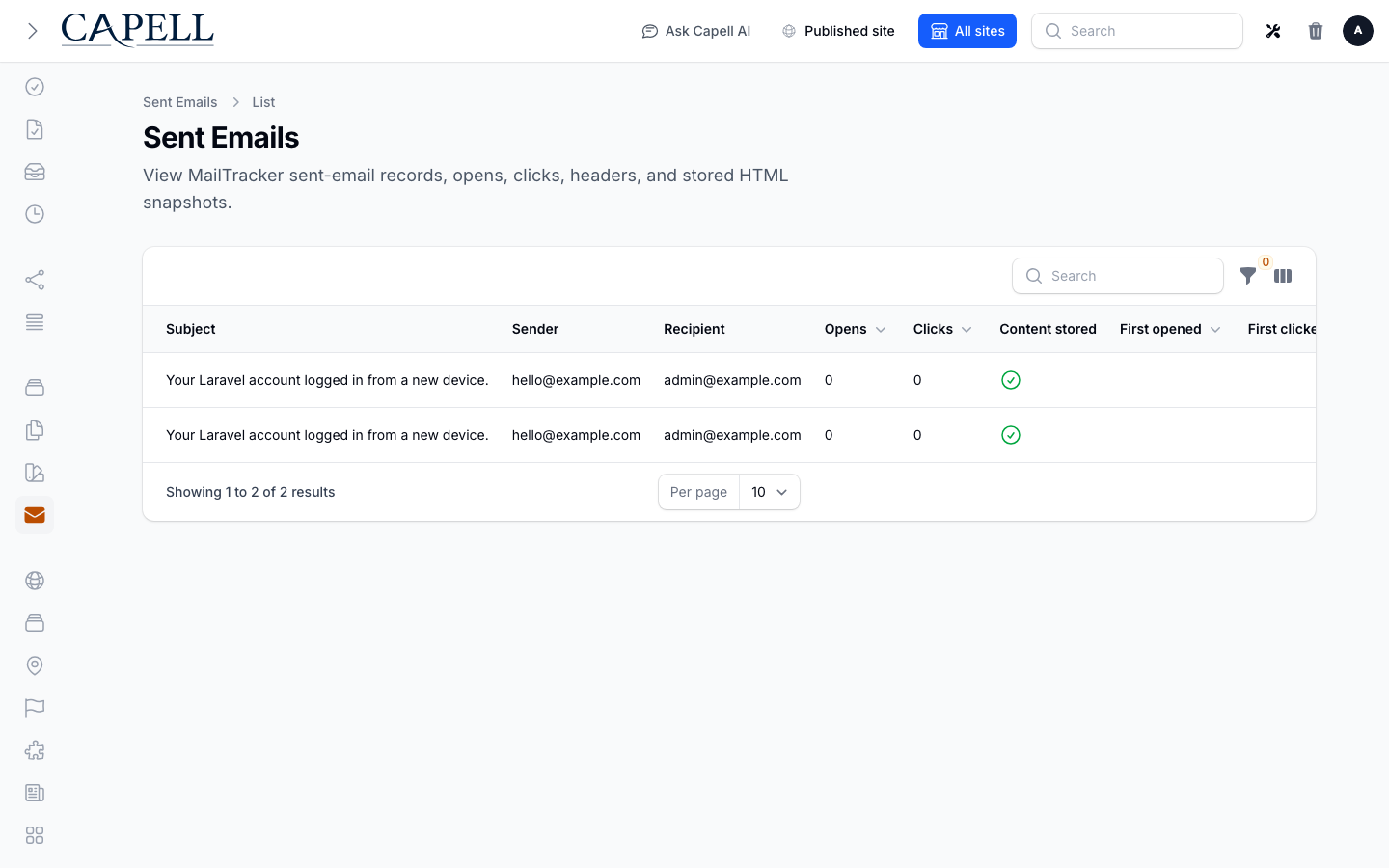
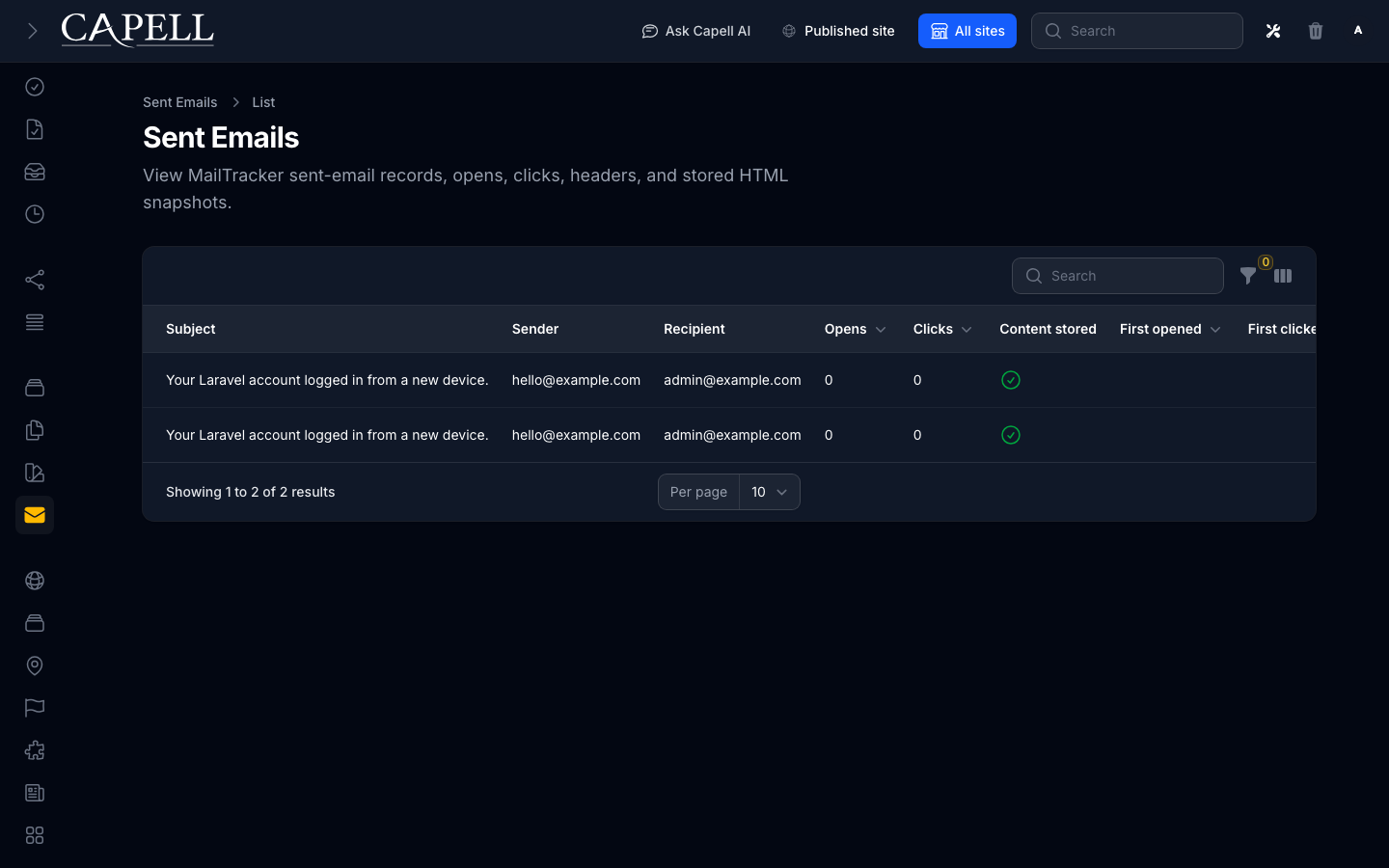
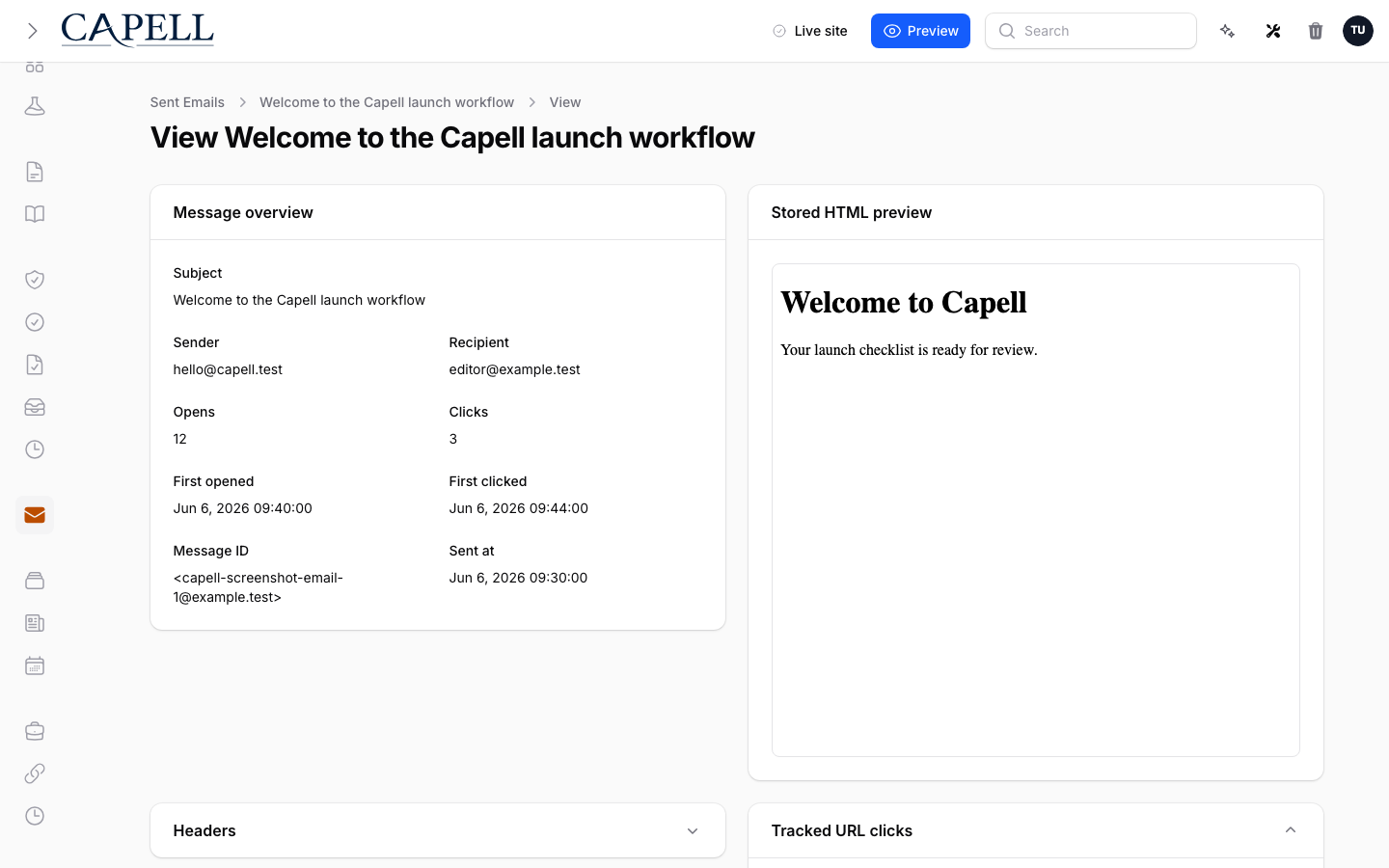
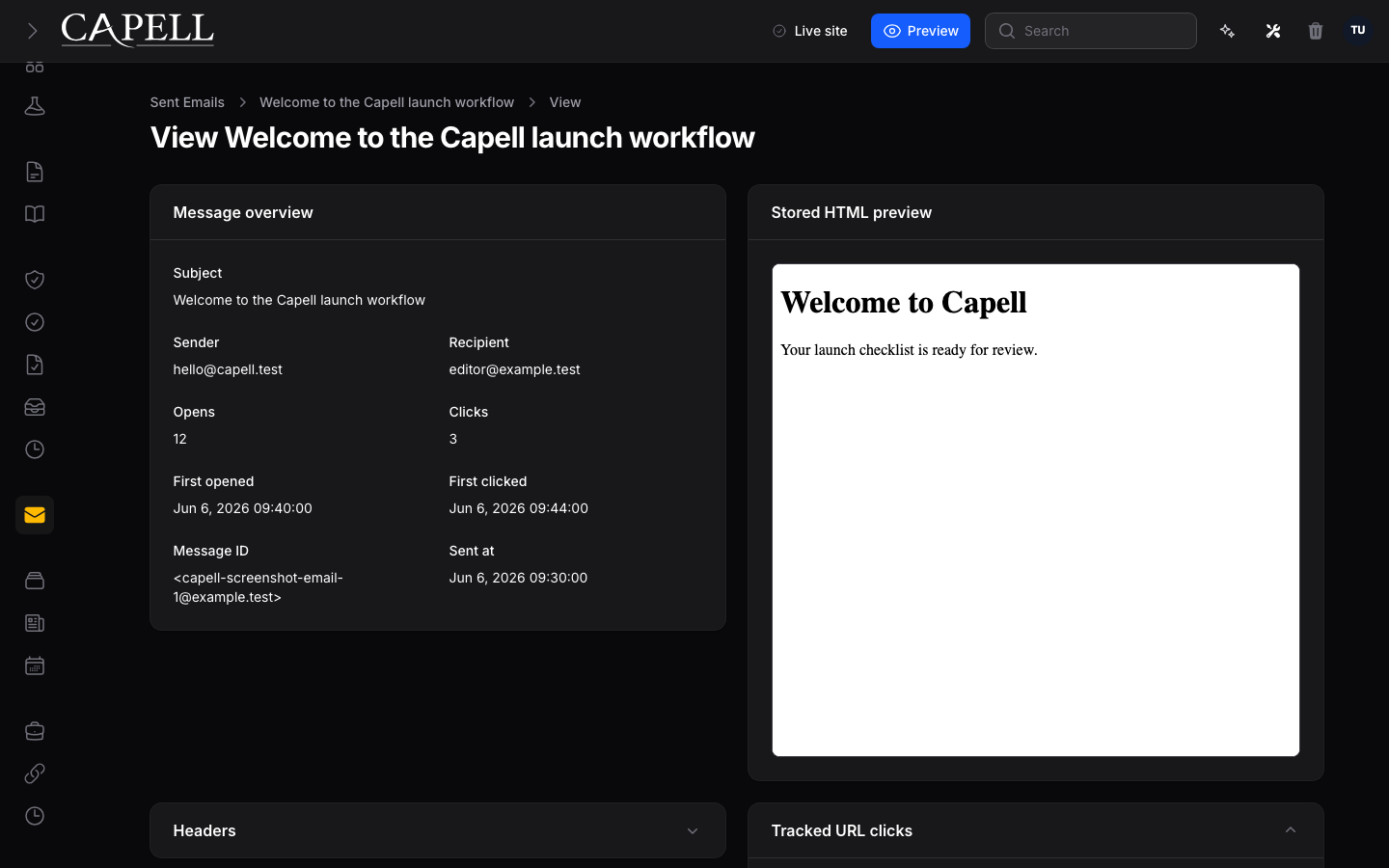
- Sent emails admin index (admin, required evidence).
- Sent email detail view (admin, required evidence).
- Registered email templates index (admin, supplementary evidence).
- Email template themes (admin, supplementary evidence).
- Email template variant editor (admin, supplementary evidence).
- Email template preview and send test action (admin, supplementary evidence).
- Email Studio settings (admin, supplementary evidence).
- Sent emails admin index with admin sidebar menu open (admin, supplementary evidence).
Technical Shape
Section titled “Technical Shape”Service providers
Section titled “Service providers”Capell\EmailStudio\Providers\AuthEmailServiceProviderCapell\EmailStudio\Providers\EmailStudioServiceProviderCapell\EmailStudio\Providers\AdminServiceProviderCapell\EmailStudio\Providers\FrontendServiceProvider
Config files
Section titled “Config files”packages/email-studio/config/capell-email-studio.php
Migrations
Section titled “Migrations”packages/email-studio/database/migrations/2026_05_10_190847_01_create_email_profiles_table.phppackages/email-studio/database/migrations/2026_05_10_190847_02_create_email_templates_table.phppackages/email-studio/database/migrations/2026_05_10_190847_03_create_email_template_variants_table.phppackages/email-studio/database/migrations/2026_05_10_190847_04_create_email_messages_table.phppackages/email-studio/database/migrations/2026_05_10_190847_05_create_email_recipients_table.phppackages/email-studio/database/migrations/2026_05_10_190847_06_create_email_events_table.phppackages/email-studio/database/migrations/2026_05_10_190847_07_create_email_replies_table.phppackages/email-studio/database/migrations/2026_05_10_190847_08_create_email_suppressions_table.phppackages/email-studio/database/migrations/2026_05_10_190847_09_create_email_template_registrations_table.phppackages/email-studio/database/migrations/2026_05_10_190847_10_create_email_tracking_tokens_table.phppackages/email-studio/database/migrations/2026_06_13_000001_add_email_template_authoring_tables.phppackages/email-studio/database/migrations/2026_07_12_000001_encrypt_email_studio_sensitive_data.phppackages/email-studio/database/migrations/2026_08_28_000002_change_encrypted_email_studio_columns_to_text.php
Settings migrations
Section titled “Settings migrations”packages/email-studio/database/settings/2026_06_05_000001_create_email_studio_settings.phppackages/email-studio/database/settings/2026_06_13_000001_add_email_template_authoring_settings.php
Settings classes
Section titled “Settings classes”EmailStudioSettingsEmailStudioSettingsMigrationProvider
Models
Section titled “Models”EmailEventEmailMessageEmailProfileEmailRecipientEmailReplyEmailSuppressionEmailTemplateEmailTemplateRegistrationEmailTemplateThemeEmailTemplateVariantEmailTrackingTokenSentEmailSentEmailUrlClicked
Filament classes
Section titled “Filament classes”EmailMessageResourceListEmailMessagesViewEmailMessageEmailMessageInfolistEmailTemplateThemeResourceCreateEmailTemplateThemeEditEmailTemplateThemeListEmailTemplateThemesEmailTemplateVariantResourceEditEmailTemplateVariantListEmailTemplateVariantsEmailTemplateResourceListEmailTemplatesListSentEmailsViewSentEmailSentEmailInfolistSentEmailResourceEmailStudioSettingsSchema
Route files
Section titled “Route files”packages/email-studio/routes/web.php
Policies
Section titled “Policies”AbstractEmailStudioResourcePolicyEmailMessagePolicyEmailTemplateRegistrationPolicyEmailTemplateThemePolicyEmailTemplateVariantPolicySentEmailPolicy
Extension contracts
Section titled “Extension contracts”CapturesEmailTemplateThemeScreenshotsEmailProviderAdapter
Actions
Section titled “Actions”ActivateEmailTemplateVariantActionApplyEmailTemplateThemeActionApplyMailTrackerSettingsActionBuildAuthEmailMailMessageActionBuildEmailStudioPrivacyExportActionBuildEmailTemplatePreviewActionCaptureEmailTemplateThemeScreenshotActionCheckEmailSuppressionActionCreateDefaultEmailTemplateThemeActionCreateEmailTemplateOverrideActionDeliverEmailMessageActionEraseEmailStudioPrivacyDataActionMarkEmailMessageDeliveryFailedActionPruneEmailBodiesActionPurgeTrackedEmailsActionReconcileUncertainEmailDeliveryActionRecordProviderEventActionRegisterAuthEmailTemplatesActionRegisterEmailTemplateActionRenderEmailTemplateActionRenderEmailTemplateDefinitionActionRenderResolvedEmailTemplateActionResolveEmailStudioPrivacyRecordIdsActionResolveEmailTemplateVariantActionResolveProviderWebhookProfileActionSeedEmailStudioScreenshotFixtureActionSendEmailActionSendEmailTemplateTestActionSuppressEmailAddressActionValidateProviderWebhookSignatureAction
Data objects
Section titled “Data objects”EmailAddressDataEmailAttachmentDataEmailBodyPruneResultDataEmailContextDataEmailHeaderDataEmailStudioPrivacyRecordIdsDataEmailTemplateDefinitionDataEmailTemplatePreviewDataEmailTemplateVariableDataInboundEmailReplyDataProviderSendResultDataProviderWebhookEventDataRenderedEmailDataResolvedEmailTemplateDataSendEmailDataTrackedEmailPurgeResultData
SendEmailJob
Command signatures
Section titled “Command signatures”Capell\EmailStudio\Console\Commands\PurgeTrackedEmailsCommandcapell-email-studio:prune-bodies
Manifest action API
Section titled “Manifest action API”activateTemplateVariant: Capell\EmailStudio\Actions\ActivateEmailTemplateVariantActionapplyMailTrackerSettings: Capell\EmailStudio\Actions\ApplyMailTrackerSettingsActioncaptureTemplateThemeScreenshot: Capell\EmailStudio\Actions\CaptureEmailTemplateThemeScreenshotActioncreateTemplateOverride: Capell\EmailStudio\Actions\CreateEmailTemplateOverrideActionpurgeTrackedEmails: Capell\EmailStudio\Actions\PurgeTrackedEmailsActionrecordProviderEvent: Capell\EmailStudio\Actions\RecordProviderEventActionrenderStaticTemplateDefinition: Capell\EmailStudio\Actions\RenderEmailTemplateDefinitionActionsendTemplateTest: Capell\EmailStudio\Actions\SendEmailTemplateTestActionvalidateProviderWebhookSignature: Capell\EmailStudio\Actions\ValidateProviderWebhookSignatureAction
Scheduled commands
Section titled “Scheduled commands”capell-email-studio:purge-tracked-emails (daily; package registered)
Console command classes
Section titled “Console command classes”PruneEmailBodiesCommandPurgeTrackedEmailsCommandSeedEmailStudioScreenshotFixtureCommand
Manifest contributions
Section titled “Manifest contributions”admin-resource: Capell\EmailStudio\Manifest\EmailMessageResourceContributionadmin-resource: Capell\EmailStudio\Manifest\SentEmailResourceContributionadmin-resource: Capell\EmailStudio\Manifest\TemplateAuthoringResourceContributionmodel: Capell\EmailStudio\Manifest\SentEmailModelContributionscheduled-job: Capell\EmailStudio\Manifest\TrackedEmailPurgeScheduleContributionsetting: Capell\EmailStudio\Manifest\EmailStudioSettingsContribution
Health checks
Section titled “Health checks”Capell\EmailStudio\Health\EmailStudioHealthCheck
Blade views
Section titled “Blade views”packages/email-studio/resources/views/emails/auth-rendered.blade.phppackages/email-studio/resources/views/emails/auth/lockout.blade.phppackages/email-studio/resources/views/emails/auth/login.blade.phppackages/email-studio/resources/views/emails/auth/password-reset-success.blade.phppackages/email-studio/resources/views/emails/auth/reset-password.blade.phppackages/email-studio/resources/views/emails/auth/verified.blade.phppackages/email-studio/resources/views/emails/auth/verify-email.blade.phppackages/email-studio/resources/views/emails/auth/welcome.blade.phppackages/email-studio/resources/views/emails/themes/default.blade.phppackages/email-studio/resources/views/filament/email-templates/preview.blade.phppackages/email-studio/resources/views/filament/sent-emails/click-rows.blade.phppackages/email-studio/resources/views/filament/sent-emails/content-preview.blade.php
Cache tags
Section titled “Cache tags”email-studio
Data Model
Section titled “Data Model”- Required tables:
email_events,email_messages,email_profiles,email_recipients,email_replies,email_suppressions,email_template_registrations,email_template_themes,email_template_variants,email_templates,email_tracking_tokens,sent_emails,sent_emails_url_clicked. - Models:
EmailEvent,EmailMessage,EmailProfile,EmailRecipient,EmailReply,EmailSuppression,EmailTemplate,EmailTemplateRegistration,EmailTemplateTheme,EmailTemplateVariant,EmailTrackingToken,SentEmail,SentEmailUrlClicked. - Core record references in migrations:
sites via site_id. - Migration files:
2026_05_10_190847_01_create_email_profiles_table.php,2026_05_10_190847_02_create_email_templates_table.php,2026_05_10_190847_03_create_email_template_variants_table.php,2026_05_10_190847_04_create_email_messages_table.php,2026_05_10_190847_05_create_email_recipients_table.php,2026_05_10_190847_06_create_email_events_table.php,2026_05_10_190847_07_create_email_replies_table.php,2026_05_10_190847_08_create_email_suppressions_table.php,2026_05_10_190847_09_create_email_template_registrations_table.php,2026_05_10_190847_10_create_email_tracking_tokens_table.php,2026_06_13_000001_add_email_template_authoring_tables.php,2026_07_12_000001_encrypt_email_studio_sensitive_data.php,2026_08_28_000002_change_encrypted_email_studio_columns_to_text.php. - Migration impact: run host migrations through the package install flow before opening package surfaces.
- Deletion/retention behaviour: migrations declare cascade-on-delete relationships, null-on-delete relationships, and restricted-delete relationships; retention is scheduled through
capell-email-studio:purge-tracked-emails(daily; registered by the package provider).
Install Impact
Section titled “Install Impact”- Required packages:
capell-app/admin,capell-app/core,capell-app/frontend. - Admin navigation: declares
admin-resource: EmailMessageResourceContribution,admin-resource: SentEmailResourceContribution,admin-resource: TemplateAuthoringResourceContribution; each Filament page or resource controls its own navigation visibility. - Admin/editor extensions: none declared.
- Permissions:
ViewAny:SentEmail,View:SentEmail,ViewAny:EmailMessage,View:EmailMessage,ViewAny:EmailTemplateRegistration,View:EmailTemplateRegistration,ViewAny:EmailTemplateVariant,View:EmailTemplateVariant,Update:EmailTemplateVariant,ViewAny:EmailTemplateTheme,View:EmailTemplateTheme,Create:EmailTemplateTheme,Update:EmailTemplateTheme; access also governed by package policies:AbstractEmailStudioResourcePolicy,EmailMessagePolicy,EmailTemplateRegistrationPolicy,EmailTemplateThemePolicy,EmailTemplateVariantPolicy,SentEmailPolicy. - Public routes: loads
routes/web.php. - Database changes: package migrations are declared.
- Config:
config/capell-email-studio.php. - Settings:
Capell\EmailStudio\Settings\EmailStudioSettings,Capell\EmailStudio\Manifest\EmailStudioSettingsContribution. - Queues or schedules: scheduled commands
capell-email-studio:purge-tracked-emails (daily; package registered); queue jobsSendEmailJob. - Cache tags:
email-studio. - Commands:
Capell\EmailStudio\Console\Commands\PurgeTrackedEmailsCommand,capell-email-studio:prune-bodies.
Common Pitfalls
Section titled “Common Pitfalls”- Keep required Capell packages on compatible v4 releases:
capell-app/admin,capell-app/core,capell-app/frontend. - Run migrations before opening package resources or public routes.
- Review package configuration before production-like verification:
config/capell-email-studio.php,Capell\EmailStudio\Settings\EmailStudioSettings,Capell\EmailStudio\Manifest\EmailStudioSettingsContribution. - Review middleware, throttling, signatures, and public-output safety in
routes/web.phpbefore exposing routes. - Keep the host Laravel scheduler running so package-registered schedules can execute:
capell-email-studio:purge-tracked-emails (daily; package registered). - Keep public Blade and cached HTML free of authoring markers, model IDs, permissions, signed editor URLs, and lazy database queries.
- Custom write integrations must preserve invalidation for
email-studiocache tags.
Troubleshooting
Section titled “Troubleshooting”| Symptom | Likely cause | Check | Fix |
|---|---|---|---|
| Package surface is missing after install | Provider or manifest is not loaded | Confirm capell.json, package composer.json, and provider registration | Reinstall the package, refresh Composer autoload, and clear host caches |
| Admin screen or command fails on missing table | Package migrations have not run | Check the tables listed in Data Model | Run host migrations and rerun the focused package test |
| Route returns unexpected output | Route cache, middleware, or signed URL setup does not match the package route file | Check the route files listed in Technical Shape | Clear route cache and verify middleware before exposing public routes |
| Background work does not run | Queue worker or declared schedule is not active | Check the jobs and scheduled commands listed in Technical Shape | Start the queue worker or host scheduler, then run the focused command or package test |
| Public output leaks unexpected state | Render data, cache variation, or authoring boundary has regressed | Check public Blade, cache tags, and public-output safety tests | Move data loading out of Blade and rerun the package public-output tests |
Quick Start
Section titled “Quick Start”- Install the package:
composer require capell-app/email-studio. - Open the package admin surface at
/admin/email-studio/sent-emailsand confirm Email Studio is available.
Next Steps
Section titled “Next Steps”- Package docs
- Overview
- Worked extension examples
- Admin guide
- API and extension points
- Database and schema reference
- Configuration files:
config/capell-email-studio.php. - Troubleshooting
- Screenshot contract
- Marketplace assets
- Capell content language plan
- Capell documentation design system
- Capell and package ERD notes
- Related packages: Campaign Studio, Form Builder, Insights.