
Navigation
Package docs status
Section titled “Package docs status”This page is generated from package source documentation in the Capell packages repository and the checked-in manifest. Source documentation is not distribution status. Before running a Composer command, verify that the exact package and compatible 1.x release are available through public Packagist or the authenticated marketplace account.
| Field | Value |
|---|---|
| Composer package | capell-app/navigation |
| Package slug | navigation |
| Product group | Capell Foundation |
| Tier | free |
| Bundle | foundation |
| Runtime contexts | admin, frontend, console |
| Capell version | ^1.0 |
| Catalogue role | extension |
| Release channel | Released |
| Source repository | capell-app/packages |
| Source path | packages/navigation |
| Docs source | packages/navigation/docs |
| Manifest | capell.json |
What This Plugin Adds
Section titled “What This Plugin Adds”Navigation is an Available, Schema-owning Capell package in the Capell Foundation product group. It ships as capell-app/navigation and extends these surfaces: admin, frontend, console.
Navigation adds site- and language-scoped menus with page links, external links, nested items, publication state, and reusable handles.
Editors build and order menus in admin, and public themes receive hydrated navigation with safe URLs, active states, and nested children.
Status details:
- Status: Available
- Tier: free
- Bundle: foundation
- Composer package:
capell-app/navigation - Namespace:
Capell\Navigation - Theme key: not applicable
Why It Matters
Section titled “Why It Matters”For developers: The navigable and handle registries let packages contribute linkable records and named menus without reaching into Navigation internals.
For teams: Editors can keep site menus current, reorder links, and reuse the same menu structure across theme output without code changes.
Screens And Workflow
Section titled “Screens And Workflow”Screenshot contract: docs/screenshots.json.
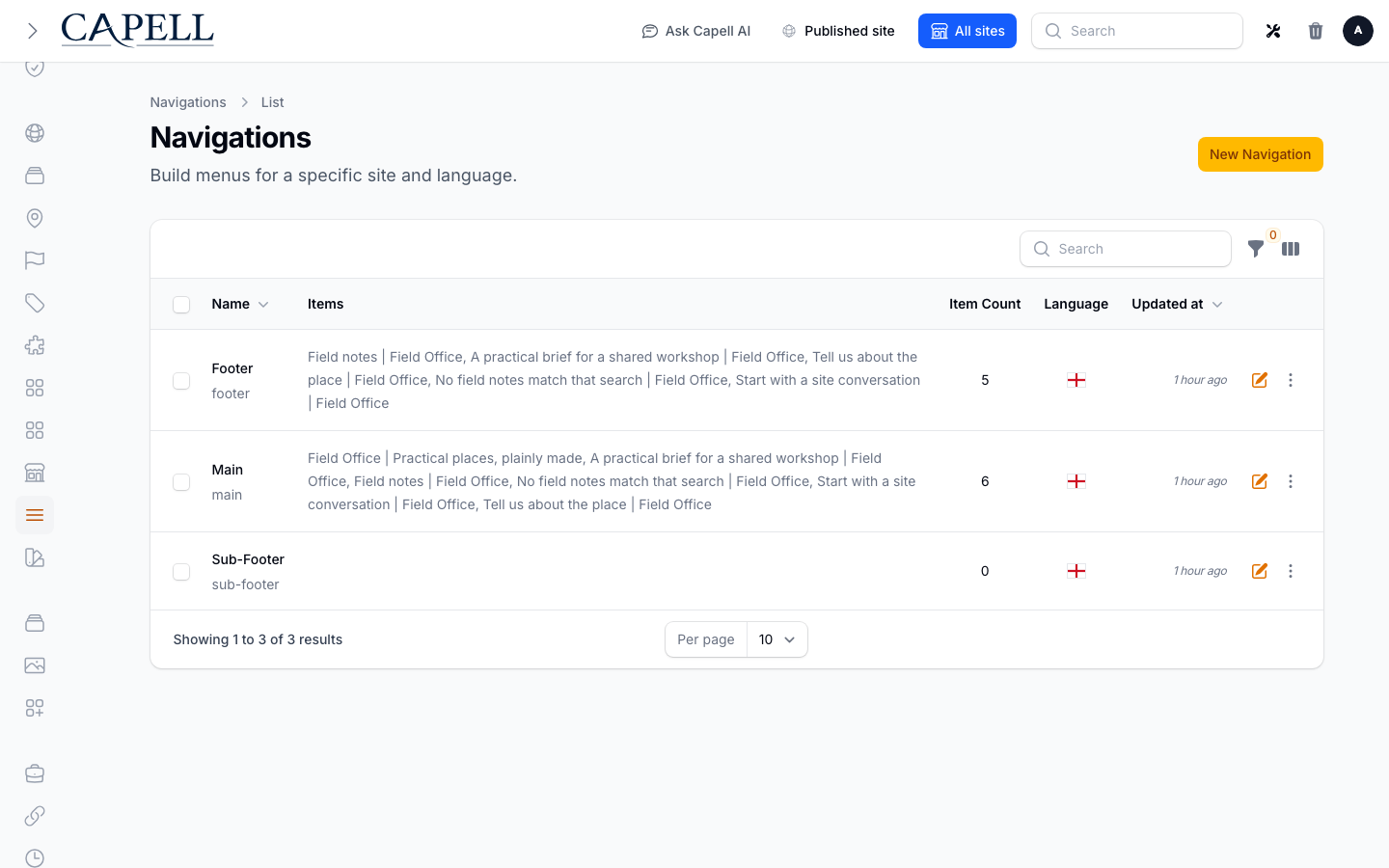
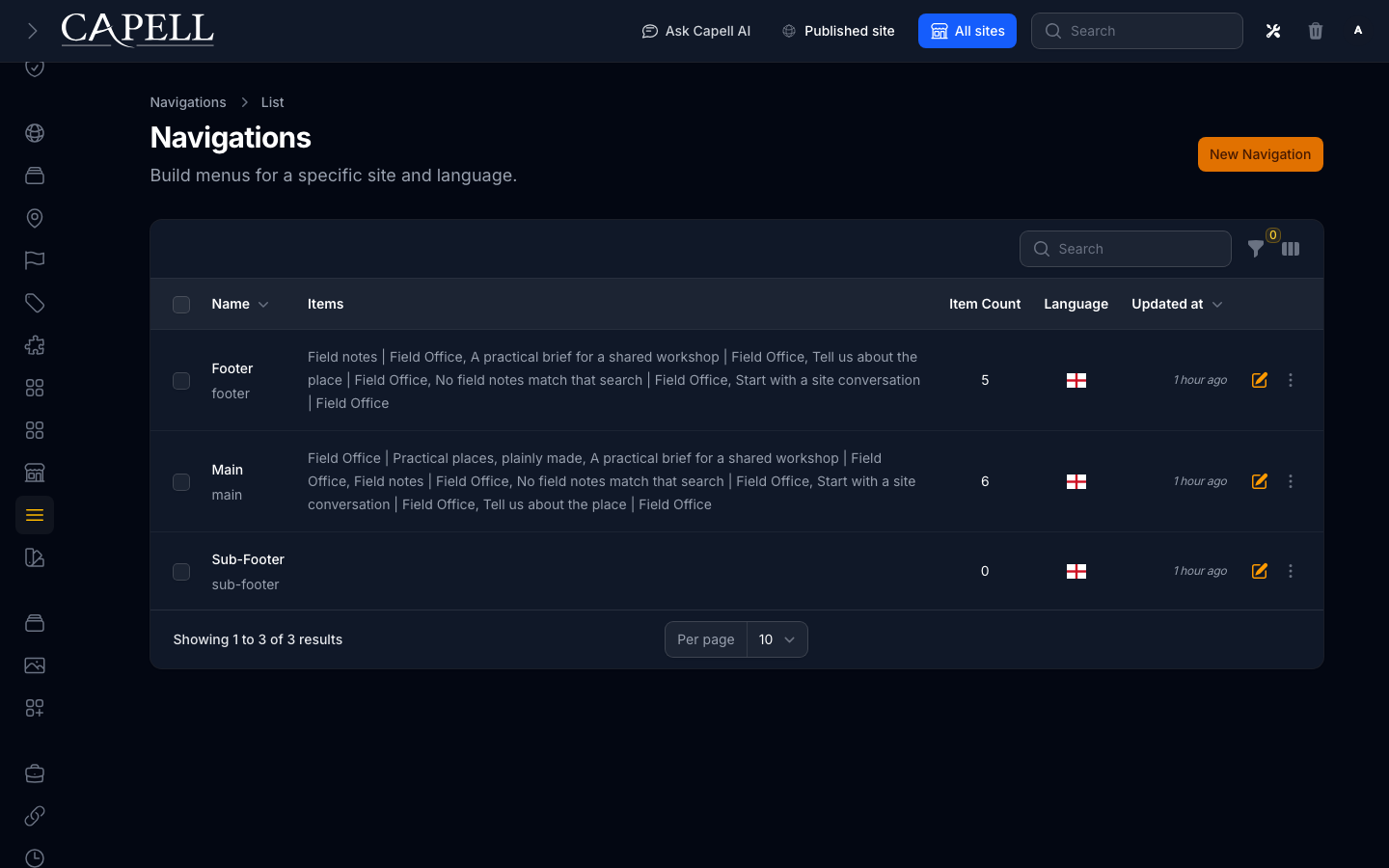
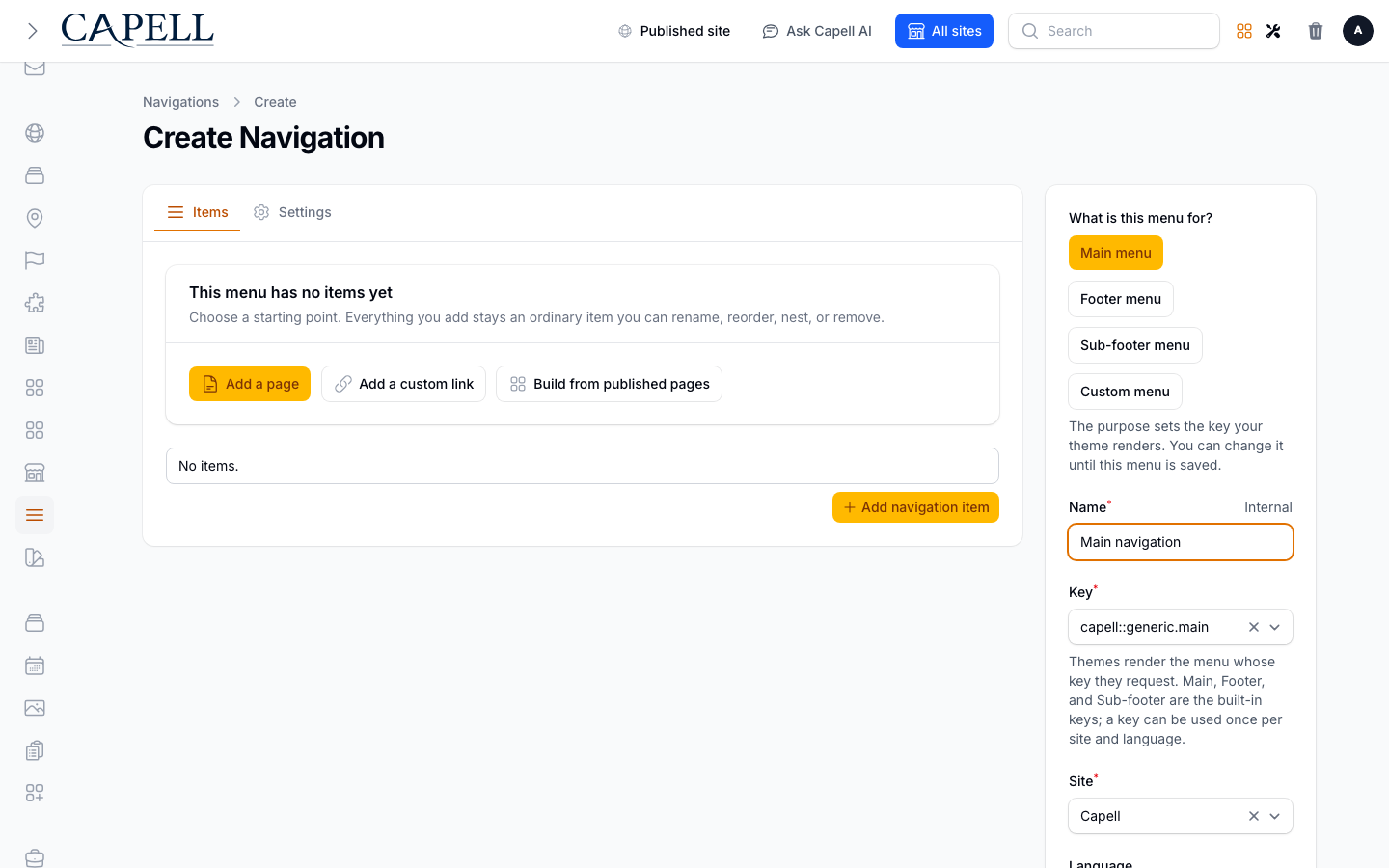
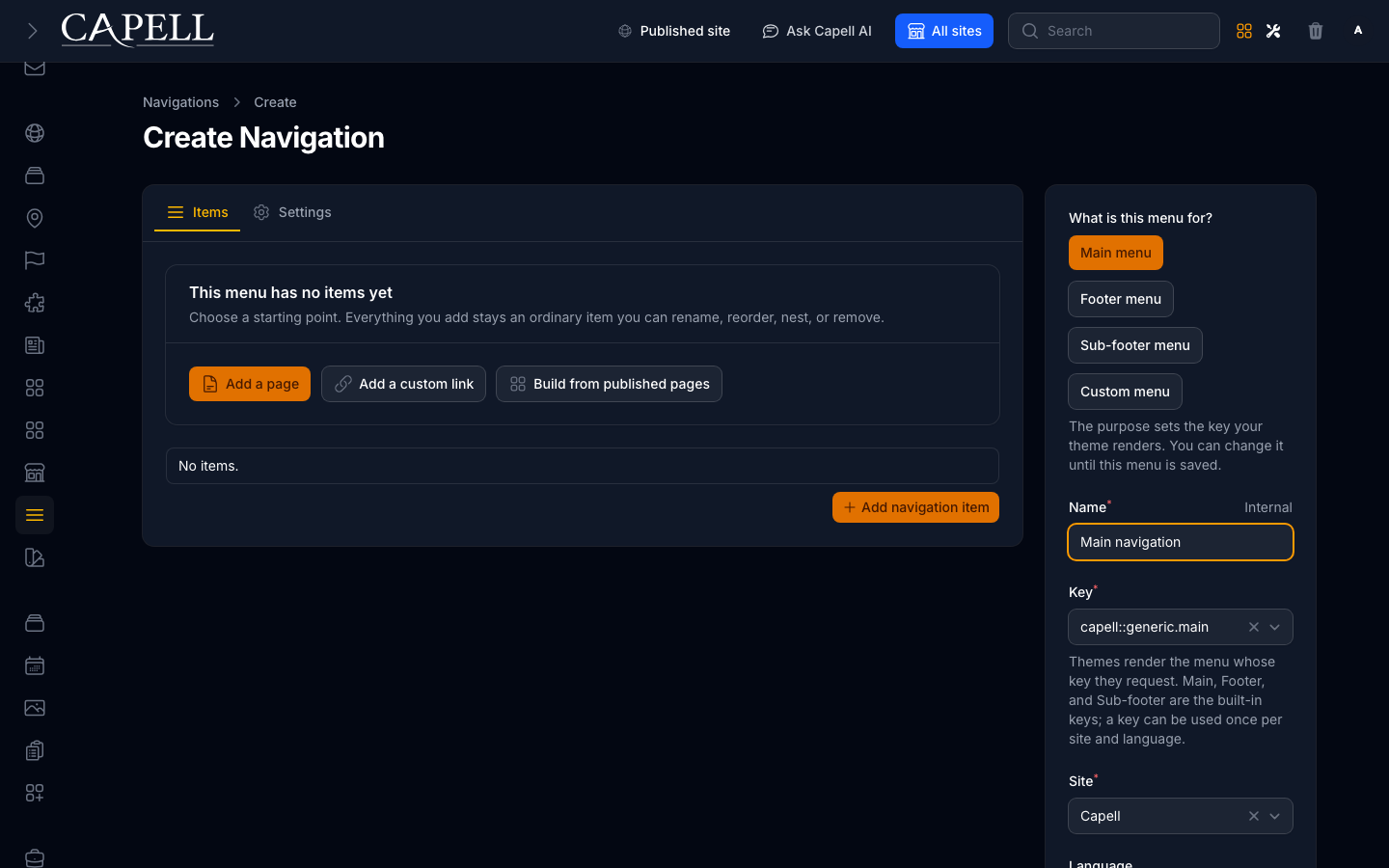
- Navigation admin index (admin, required evidence).
- Create/edit navigation form on desktop (admin, required evidence).
- Create/edit navigation form on tablet (admin, required evidence).
- Create/edit navigation form on mobile (admin, required evidence).
- Site relation manager for navigations (admin, supplementary evidence).
- Page form navigation tab (admin, required evidence).
- Frontend menu output (frontend, required evidence).
- Navigation admin index with admin sidebar menu open (admin, supplementary evidence).
Technical Shape
Section titled “Technical Shape”Service providers
Section titled “Service providers”Capell\Navigation\Providers\NavigationServiceProviderCapell\Navigation\Providers\ConsoleServiceProvider
Config files
Section titled “Config files”packages/navigation/config/capell-navigation.php
Migrations
Section titled “Migrations”packages/navigation/database/migrations/2026_05_10_190860_01_create_navigations_table.phppackages/navigation/database/migrations/2026_06_04_000001_create_navigation_page_references_table.phppackages/navigation/database/migrations/2026_08_28_000003_change_navigation_visibility_to_datetime.php
Models
Section titled “Models”Navigation
Filament classes
Section titled “Filament classes”TypeSelectNavigationSelectNavigationTabNavigationItemsColumnDefaultNavigationConfiguratorNavigationPageSchemaExtenderNavigationSiteExtenderNavigationResourceCreateNavigationEditNavigationListNavigationsNavigationFormNavigationsTableNavigationsRelationManager
Route files
Section titled “Route files”packages/navigation/routes/web.php
Policies
Section titled “Policies”NavigationPolicy
Extension contracts
Section titled “Extension contracts”NavigationNamesResolverNavigationPageSyncer
Events
Section titled “Events”NavigationCreating
Listeners
Section titled “Listeners”ReplicateSiteNavigationsListener
Actions
Section titled “Actions”AddPageToNavigationActionApplyNavigationSiteSpecActionBuildNavigationBreadcrumbsActionBuildNavigationChildFragmentActionBuildNavigationImpactPreviewActionBuildNavigationRenderModelActionBuildNavigationStarterItemsActionBuildPageNavigationReferencesActionEnsureNavigationItemKeysActionRemovePageFromNavigationActionReplicateSiteNavigationsActionResolveNavigationCacheExpiryActionResolveNavigationItemModelsActionScalarizeNavigationDataActionSeedNavigationScreenshotFixtureActionSyncNavigationPageReferencesAction
Data objects
Section titled “Data objects”NavigationItemDataNavigationItemRenderDataNavigationRenderContextDataNavigationRenderDataNavigationStarterItemsDataNavigationStarterRequestData
Command signatures
Section titled “Command signatures”capell:navigation-democapell:navigation-setupcapell:navigation:screenshot-fixture
Console command classes
Section titled “Console command classes”DemoCommandSeedNavigationScreenshotFixtureCommandSetupCommand
Manifest contributions
Section titled “Manifest contributions”admin-resource: Capell\Navigation\Manifest\NavigationAdminResourceContributionconfigurator: Capell\Navigation\Manifest\NavigationConfiguratorContributionconfigurator: Capell\Navigation\Manifest\NavigationContentGraphContributionconfigurator: Capell\Navigation\Manifest\NavigationFrontendRuntimeContributionconsole-command: Capell\Navigation\Manifest\NavigationConsoleCommandsContributionfrontend-component: Capell\Navigation\Manifest\NavigationFrontendComponentsContributionhealth-check: Capell\Navigation\Manifest\NavigationHealthContributionmigration: Capell\Navigation\Manifest\NavigationMigrationsContributionmodel: Capell\Navigation\Manifest\NavigationModelsContributionpage-type: Capell\Navigation\Manifest\NavigationPageTypeContributionrender-hook: Capell\Navigation\Manifest\NavigationRenderHookContributionroute: Capell\Navigation\Manifest\NavigationFrontendRouteContributionschema-extender: Capell\Navigation\Manifest\NavigationSchemaExtendersContribution
Health checks
Section titled “Health checks”Capell\Navigation\Health\NavigationHealthCheck
Blade views
Section titled “Blade views”packages/navigation/resources/views/components/breadcrumbs.blade.phppackages/navigation/resources/views/components/header/main-navigation.blade.phppackages/navigation/resources/views/components/header/menu/dropdown.blade.phppackages/navigation/resources/views/components/header/menu/item.blade.phppackages/navigation/resources/views/components/header/navigation.blade.phppackages/navigation/resources/views/components/menu-items.blade.phppackages/navigation/resources/views/components/menu.blade.phppackages/navigation/resources/views/components/page/navigations.blade.phppackages/navigation/resources/views/filament/forms/navigation-impact-preview.blade.php
Cache tags
Section titled “Cache tags”navigation
Data Model
Section titled “Data Model”- Required tables:
navigations,navigation_page_references. - Models:
Navigation. - Core record references in migrations:
sites via site_id,languages via language_id. - Migration files:
2026_05_10_190860_01_create_navigations_table.php,2026_06_04_000001_create_navigation_page_references_table.php,2026_08_28_000003_change_navigation_visibility_to_datetime.php. - Migration impact: run host migrations through the package install flow before opening package surfaces.
- Deletion/retention behaviour: migrations declare cascade-on-delete relationships; no timed pruning or retention schedule is declared in
capell.json.
Install Impact
Section titled “Install Impact”- Required packages:
capell-app/admin,capell-app/core,capell-app/frontend. - Admin navigation: declares
admin-resource: NavigationAdminResourceContribution; each Filament page or resource controls its own navigation visibility. - Admin/editor extensions:
configurator: NavigationConfiguratorContribution,configurator: NavigationContentGraphContribution,configurator: NavigationFrontendRuntimeContribution,schema-extender: NavigationSchemaExtendersContribution. - Permissions:
ViewAny:Navigation,View:Navigation,Create:Navigation,Update:Navigation,Delete:Navigation,DeleteAny:Navigation,Restore:Navigation,RestoreAny:Navigation,ForceDelete:Navigation,ForceDeleteAny:Navigation,Reorder:Navigation; access also governed by package policies:NavigationPolicy. - Public routes: loads
routes/web.php; registersNavigationFrontendRouteContribution. - Database changes: package migrations are declared.
- Config:
config/capell-navigation.php. - Settings: no package settings declared.
- Queues or schedules: none declared.
- Cache tags:
navigation. - Commands:
capell:navigation-demo,capell:navigation-setup,capell:navigation:screenshot-fixture.
Common Pitfalls
Section titled “Common Pitfalls”- Keep required Capell packages on compatible v4 releases:
capell-app/admin,capell-app/core,capell-app/frontend. - Run migrations before opening package resources or public routes.
- Review package configuration before production-like verification:
config/capell-navigation.php. - Review middleware, throttling, signatures, and public-output safety in
routes/web.phpbefore exposing routes. - Keep public Blade and cached HTML free of authoring markers, model IDs, permissions, signed editor URLs, and lazy database queries.
- Custom write integrations must preserve invalidation for
navigationcache tags.
Troubleshooting
Section titled “Troubleshooting”| Symptom | Likely cause | Check | Fix |
|---|---|---|---|
| Package surface is missing after install | Provider or manifest is not loaded | Confirm capell.json, package composer.json, and provider registration | Reinstall the package, refresh Composer autoload, and clear host caches |
| Admin screen or command fails on missing table | Package migrations have not run | Check the tables listed in Data Model | Run host migrations and rerun the focused package test |
| Route returns unexpected output | Route cache, middleware, or signed URL setup does not match the package route file | Check the route files listed in Technical Shape | Clear route cache and verify middleware before exposing public routes |
| Public output leaks unexpected state | Render data, cache variation, or authoring boundary has regressed | Check public Blade, cache tags, and public-output safety tests | Move data loading out of Blade and rerun the package public-output tests |
Quick Start
Section titled “Quick Start”- Install the package:
composer require capell-app/navigation. - Run the package setup:
php artisan capell:navigation-setup. - See it working: run
php artisan capell:navigation-demo. - Open the package admin surface at
/admin/navigation/navigationsand confirm Navigation is available.