
Frontend Resources
Capell uses one typed resource graph for application Vite entries, package-published files, trusted CDN resources, inline trusted code, loading strategies, hints, dependency ordering, diagnostics, and optimization. Use this graph for CSS and JavaScript; render hooks are for public markup.
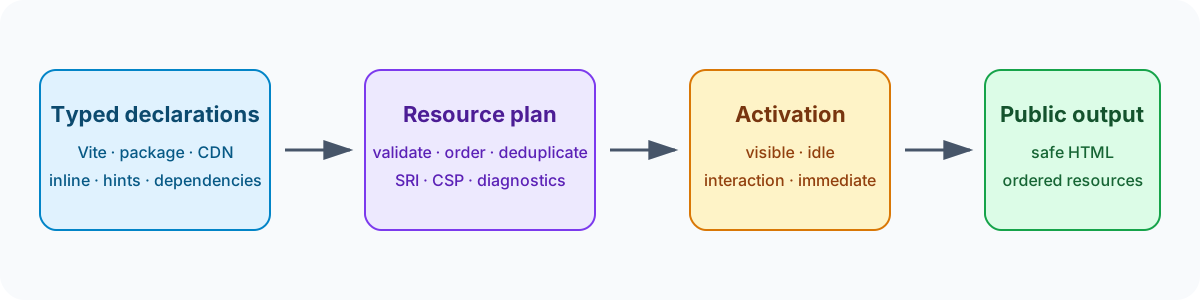
Application Vite entries and dependencies
Section titled “Application Vite entries and dependencies”Register npm requirements with FrontendPackageDependencyRegistry:
$registry->register(new FrontendPackageDependencyData( name: 'swiper', versionConstraint: '^12.0', type: FrontendPackageDependencyType::Runtime, package: 'acme/gallery',));Contribute the application entry with new ViteResourceSourceData('resources/js/gallery.js'). Run php artisan capell:frontend-after-install to print the deterministic dependency, Vite-input, publication, and build plan. Non-interactive execution mutates only with --apply.
Applications must include the generated entries:
import { capellViteInputs } from './vendor/capell-app/frontend/resources/js/capell-vite-inputs.js'
laravel({    input: [        'resources/css/app.css',        'resources/js/app.js',        ...capellViteInputs(),    ],})
Doctor reports missing integration when generated entries exist.
Published package resources and conditional widgets
Section titled “Published package resources and conditional widgets”Published files remain outside Vite. Register a typed group for LayoutBuilder selection:
$resources->register(new FrontendResourceGroupData( key: 'acme.gallery', label: 'Gallery', package: 'acme/gallery', resources: [ FrontendResourceData::style( handle: 'acme/gallery:style', package: 'acme/gallery', source: new PublicResourceSourceData('/vendor/acme-gallery/gallery.css'), loadingStrategy: PresentationLoadingStrategy::Visible, ), FrontendResourceData::classicScript( handle: 'acme/gallery:runtime', package: 'acme/gallery', source: new PublicResourceSourceData('/vendor/acme-gallery/gallery.js'), loadingStrategy: PresentationLoadingStrategy::Visible, ), ],));LayoutBuilder is the selection-to-activation bridge. Visible, idle, and interaction targets remain independent; shared canonical resources load on the first valid trigger and are deduplicated.
Trusted CDN resources
Section titled “Trusted CDN resources”The simple CDN case is concise:
FrontendResourceData::classicScript( handle: 'acme/maps:leaflet', package: 'acme/maps',);Add security metadata when available:
new ExternalResourceSourceData( integrity: 'sha384-BASE64_DIGEST', crossOrigin: CrossOrigin::Anonymous, referrerPolicy: ReferrerPolicy::NoReferrer,);External URLs must be absolute HTTPS without credentials or fragments; query strings are preserved. capell-frontend.external_resources.integrity_policy is warn by default and require rejects missing SRI.
Declare dependent libraries by stable handle:
$plugin = FrontendResourceData::classicScript( handle: 'acme/charts:labels', package: 'acme/charts', dependsOn: ['acme/charts:library'],);Async scripts cannot declare or satisfy ordered dependencies.
Hints, CSP, and trust
Section titled “Hints, CSP, and trust”Trusted PHP may use inlineStyle() and inlineScript(); the renderer applies Laravel Vite’s nonce. Use typed FrontendResourceHintData for preload, module-preload, preconnect, and DNS-prefetch. Capell does not automatically preconnect to external origins.
Plans report required script-src, style-src, connect-src, and font-src origins but do not change CSP headers. The application owns CSP authorization and nonce propagation.
Editor-controlled theme data may select trusted registered groups or local public paths. It cannot introduce remote URLs or inline executable code.
Diagnostics and tests
Section titled “Diagnostics and tests”Doctor and page-resource diagnostics report source validity, missing dependencies, cycles, aliases, package ownership, activation reasons, placement, SRI, CSP origins, local raw/gzip sizes, and remote resources as unmeasurable. Public requests never fetch third-party assets for measurement.
Tests should prove presence and absence, dependency order, placement, canonical deduplication, lazy activation, and that anonymous HTML/events contain only URLs, attributes, and opaque resource tokens—not Composer packages, internal handles, model IDs, selectors, field paths, permissions, or signed URLs.
Stylesheet recovery
Section titled “Stylesheet recovery”Critical-CSS-eligible stylesheets are rendered with Capell’s stable recovery runtime. If the intended full stylesheet fails, the runtime loads the configured stable fallback, marks the document as data-frontend-styles="fallback", and retries the intended URL with bounded cache-busting delays. A successful retry activates the full stylesheet, removes the fallback, marks the document as loaded, and dispatches capell:stylesheet-recovered. When more than one eligible stylesheet is present, the fallback remains active until every failed stylesheet has recovered.
The package default fallback is /vendor/capell-frontend/capell-frontend.css. It keeps a failed page readable, but an application with a branded frontend bundle should configure capell-frontend.stylesheet_recovery.fallback_url to a stable, atomically published full bundle. The runtime is always published at /vendor/capell-frontend/stylesheet-recovery.js; keep package assets in the normal laravel-assets publication step.
Recovery is the last safety net, not the release strategy. Content-hashed assets referenced by cacheable HTML must remain available for at least the complete HTML cache and stale-serving window. See Server Configuration.
Breaking upgrade
Section titled “Breaking upgrade”Mix, loose css()/js() builders, FrontendAssetRequirementData, FrontendAssetManifestData, FrontendAssetContributor, FrontendAssetManifestRenderer, VendorAssetData::buildAsset(), and VendorAssetData::npmDependency() were removed. Use typed source/factory declarations, FrontendResourceContributor, FrontendResourcePlanRenderer, and FrontendPackageDependencyRegistry.